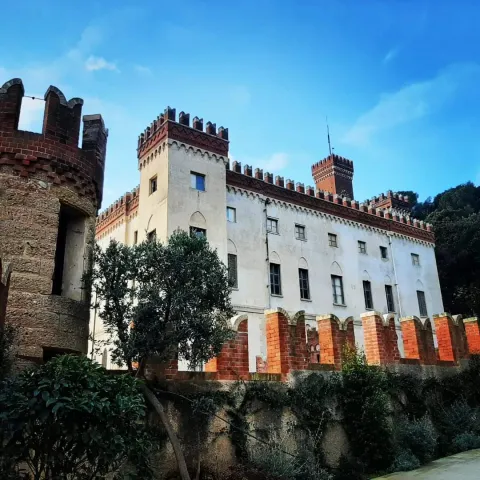
On 19 March 1920 Elena Pietracaprina Rivara signed the deed that handed Borghetto Santo Spirito a brand-new palace. She had had it built between 1915 and 1916 on piazza Libertà with money earned in Uruguay together with her husband Santiago Marexiano; when she gave it to the town council she put in writing what it was for, “the use of public offices”. The building has belonged to the municipality ever since, and it has never changed job.
What to see
The palace faces piazza Libertà and is what local records still call the old town hall. In front of the facade, since 2014, stands “Resistenza e Costituzione”: a block of white Carrara marble carved by hand by the Borghetto sculptor Simone Finotti, deliberately placed opposite the public building.
At the back is the civic library, which holds more than 25,000 volumes and has belonged since 1999 to the Val Varatella library network, along with those of Balestrino, Boissano and Toirano: a book requested here can arrive from any of the other three towns. The donor's own story is worth keeping in mind: she emigrated to Uruguay with her husband, where the two built up large industrial concerns, and she sent part of that money back to the Ligurian town in the form of walls and offices.
Visiting
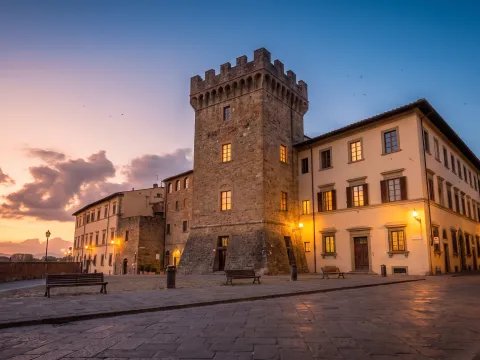
Piazza Libertà is the reference point of Borghetto Santo Spirito: from here the old via Aurelia runs 2.3 km west to Ceriale and 3.2 km east to Loano, while provincial road 60 climbs inland towards Toirano. The exterior and the sculpture can be seen at any hour; going inside means working around the public opening hours of the council offices, while the library at the back keeps its own timetable. Around it begins the rectangular old town, laid out on the model of Albenga with two main longitudinal streets.
Our editors' tip
We stop first in front of Finotti's marble, then walk round the back and into the library to ask for the local history section. That is where the palace explains itself better than it does from outside: a fortune made on the other side of the Atlantic, and the choice, set down in the deed of 1920, to bring part of it back to the square as public offices rather than a private villa. Take a moment for the title of the sculpture as well, Resistenza e Costituzione: it stands in front of the right door.