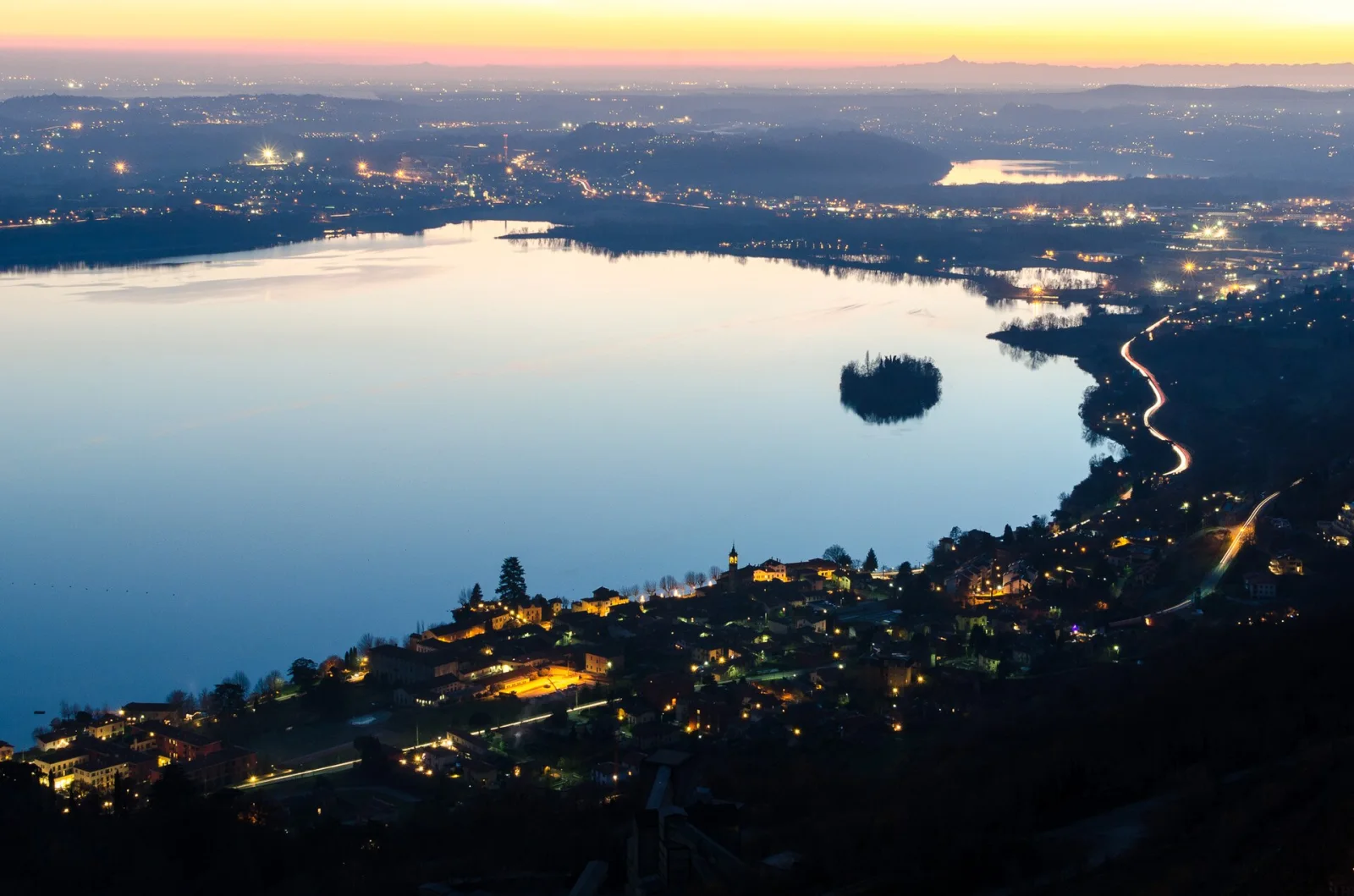
The name of this village is written on a Roman urn. Attested in 1288 as Pucilliano, the place name reflects the personal name Pusillius, and the proof is a funerary urn kept at the Paolo Giovio archaeological museum of Como, whose inscription says: to Pusilliena Ianuaria, Priscienus Secundus, coniugi incomparabili, to his incomparable wife. The lake has an even older name: Pliny the Elder, in his Naturalis Historia, calls it Eupili. In the basin a large find of red Jurassic ammonites was made, about one hundred and eighty million years old, and on the eastern side of the island of the Cypresses, the only one of the lake, remains of pile dwellings have come to light. The comune's coat of arms, which has no formal recognition, carries an uprooted tree, probably an olive: the plant that flourishes on these hills thanks to the mildness of the climate.
Palazzo Beauharnais, also known as villa Raimondi, was built from the fifteenth century by the Carpani family and owes its name to Eugène de Beauharnais, who from 1805 to 1814 used it as a residence and had the formal garden finished; from 1830 it passed to the Conti of Lecco, who converted part of it into a silk mill, in the twentieth century it was bought by the religious of the Istituto della carità, who made it partly a convent and partly a school, and since 1986 it has belonged to the comune. The west wing keeps the so-called Sala del Quattrocento, with its coffered ceiling and frames inlaid with hunting scenes, mythological scenes and headdresses of every style; and the palace is one of the subjects painted by Federico Lose and his wife Carolina in their book of 1823, the Viaggio pittorico nei monti della Brianza. Between 1855 and 1895, however, what made Pusiano famous — in Brianza, in Italy and even in France and England — were two sisters: Angela and Teresa Isacchi, illiterate and very poor, whose «parlate», uttered in moments of intense devotion, were collected and written down by their followers as the «Santa Parola», the Holy Word. Their story stayed hidden for a long time and was brought back to light by a book of the local historian Giancarlo Molteni.
Straight-line distances from the town centre. Tap a point to open its page.
Near Pusiano
The closest destinations covered by our editors, with straight-line distance.


Places to see within 25 km
Outside Pusiano, but an easy day trip away.