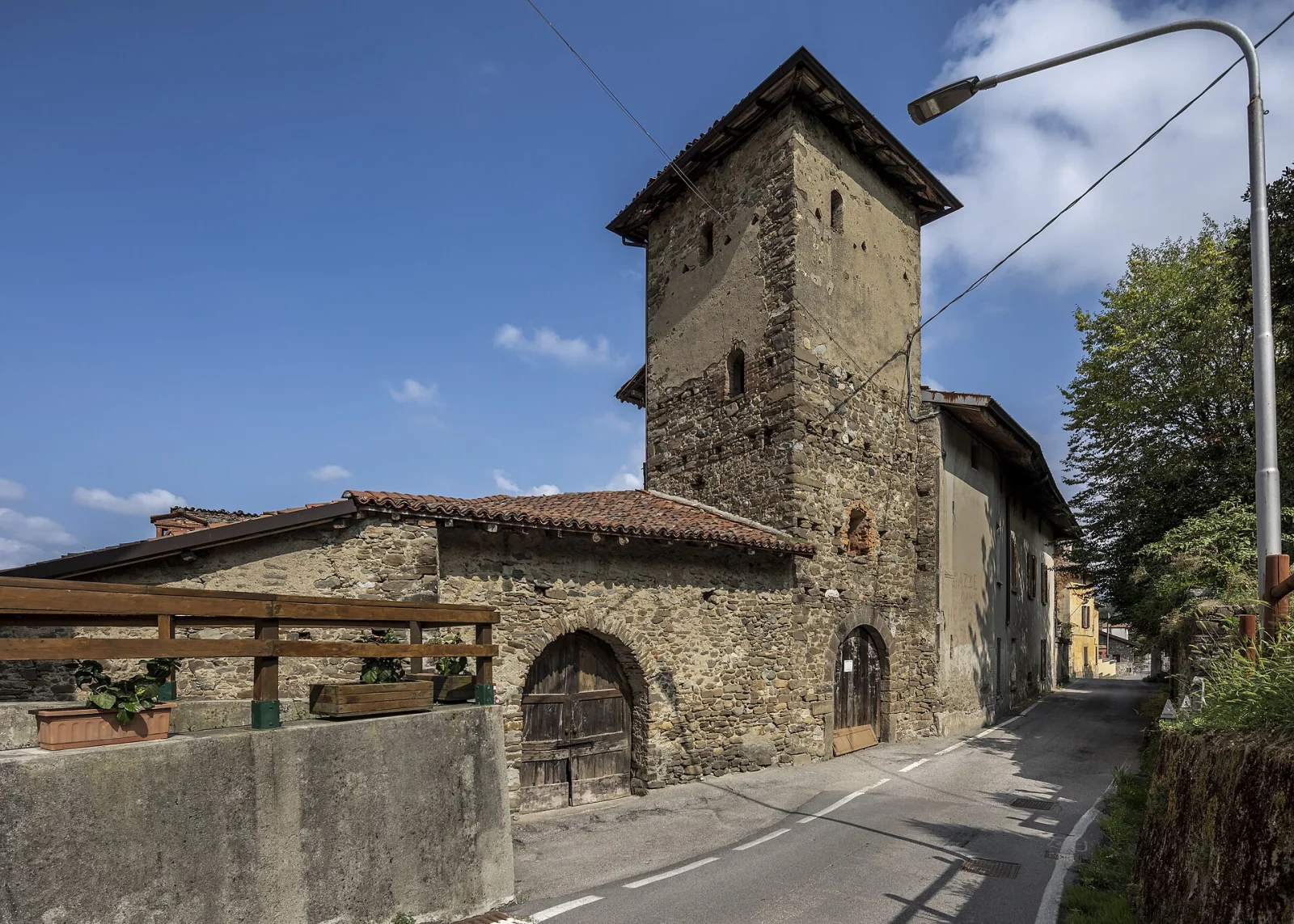
The first time Dolzago appears in a document is in 927, and the document was written in Pavia: it certifies that one Sigfrido of Milan sold the goods of "Dulciago" to the friars of the monastery of Civate. Those possessions, at the place called Cavonio, are spoken of again in a diploma of Frederick Barbarossa of 1162, and at Cavonio the church of Sant'Alessandro remains, from the second half of the twelfth century. In 1888, in the Castello hamlet, a granite lid was found: where it has ended up nobody now knows.
The village has two towers and they belong to opposite sides. In the coat of arms, granted in 1998, is the castle's tower, with Guelph battlements, surmounted by a golden cogwheel with eight spokes and twenty-four teeth — the symbol of work and progress, counted tooth by tooth. In the Castellaccio, instead, the tower is crowned with Ghibelline battlements, and has ended up inside a nineteenth-century villa. There is also the tower of Cogoredo, of early medieval origin, beside Villa Nava Brusadelli. Of the modernity the cogwheel promised there remains the memory of a stop: between 1902 and 1915 Dolzago had a station on the Monza-Barzanò-Oggiono tramway.
Straight-line distances from the town centre. Tap a point to open its page.
Near Dolzago
The closest destinations covered by our editors, with straight-line distance.


Places to see within 25 km
Outside Dolzago, but an easy day trip away.