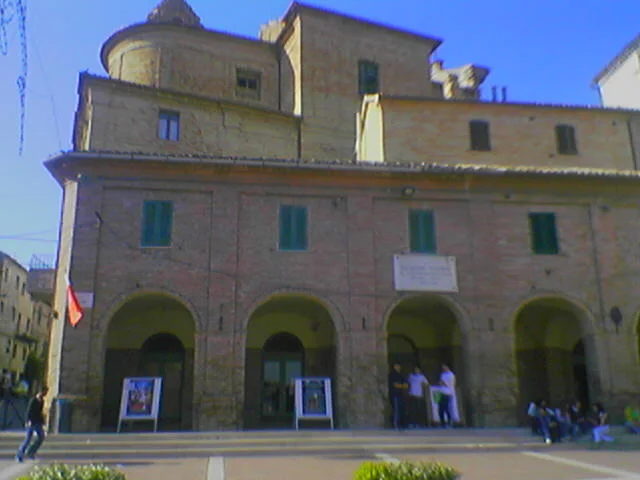
The village's name is the contraction of a Latin formula, Mons Philiorum Optrani, that is the mount of the sons of Ottrano, whom legend makes the Lombard founder of the place. Of Ottrano there is no proof, but after the war the people of Filottrano raised a statue to him and put it in the main square: a monument to a man who may never have existed. The first certain sources on the village's existence are of 1187. Under the houses runs a dense network of caves, dug to keep provisions in times of famine, of war or of particular drought; today they cannot be visited, although in some rooms one can still see the point where people used to go in. The castle walls still ring the built-up area, and the alley of the Mura Castellane is called by everyone Sótta l'Andró, that is the descent that leads from the first floor of the fortress into the moat, passing under the parapet.
A little way out stood the great monastery of Storaco, which for the people of the district was an important place of pilgrimage. Legend says that the castle and the monastery were pulled down to get the bricks with which to build the town: that is, that Filottrano is made out of the pieces of what was there before. Of the abbey church, whose origins go back to the ninth century, there remains a building closed to worship since 1986 and in a serious state of abandonment. Between the first and the ninth of July 1944 the battle of Filottrano was fought here, in which the Nembo division distinguished itself: one of the finest operations of the Italian Liberation Corps, and it is still alive in the memory of the inhabitants. In the collegiate church, finally, there are a Nativity attributed to Gerrit van Honthorst, the painter Italy called Gerardo delle Notti, and a picture of Saint Homobonus, patron of tailors and merchants: which is fitting, because Filottrano is the seat of a clothing firm known abroad.