In the Room of the Masks the painter signed his work in an unlikely place: his name is caught in Arachne's web, the weaver who challenged Minerva and lost. The inscription reads «IO DONATO PINTORE DECUMBERTINO PINSI», and for the date it uses words rather than figures, «in the year of fifty». That was 1550, and the patron was Vincenzo di Capua.
What to see
The frescoes cover every room of the piano nobile and shift in register from one to the next. In the entrance hall, fragments survive of the loves of Zeus taken from the Metamorphoses: Io taken in the form of a cloud, Europa carried off by the white bull, Danaë and the shower of gold. In the Room of the Fireplace the family celebrates itself, probably through Giovanni di Capua, who in 1495 saved the life of King Ferdinand II of Aragon. Next comes the room called of the Fire, where Sodom burns among landscape views, one of them identified as the Ponte Milvio: you enter it through a small door painted with a false curtain.
The Room of the Masks is the densest: Minerva with her owl, symbols piled on symbols, and the joint arms of the di Capua and the del Balzo. In the Room of the Pergola a trompe l'œil opens the ceiling onto a vine arbour, and among Roman countryside scenes a naval battle appears, perhaps Otranto, where Matteo di Capua was killed. The Hall of the Virtues has a polychrome sunburst at the centre of the ceiling that pulls together the roundels of the virtues credited to Vincenzo: charity, fortitude, prudence, justice, peace and faith. At the far end, past the small Room of the Reed Bed with its river landscapes, the studiolo tells of thwarted loves, Herse and the story of Cupid and Psyche, which is why it is thought to have been a bedchamber.
Our editors' tip
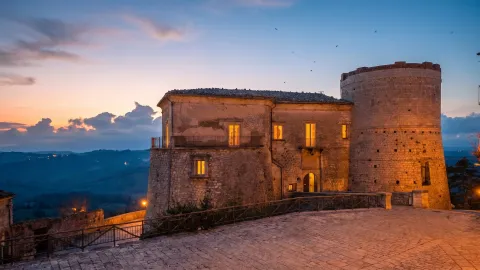
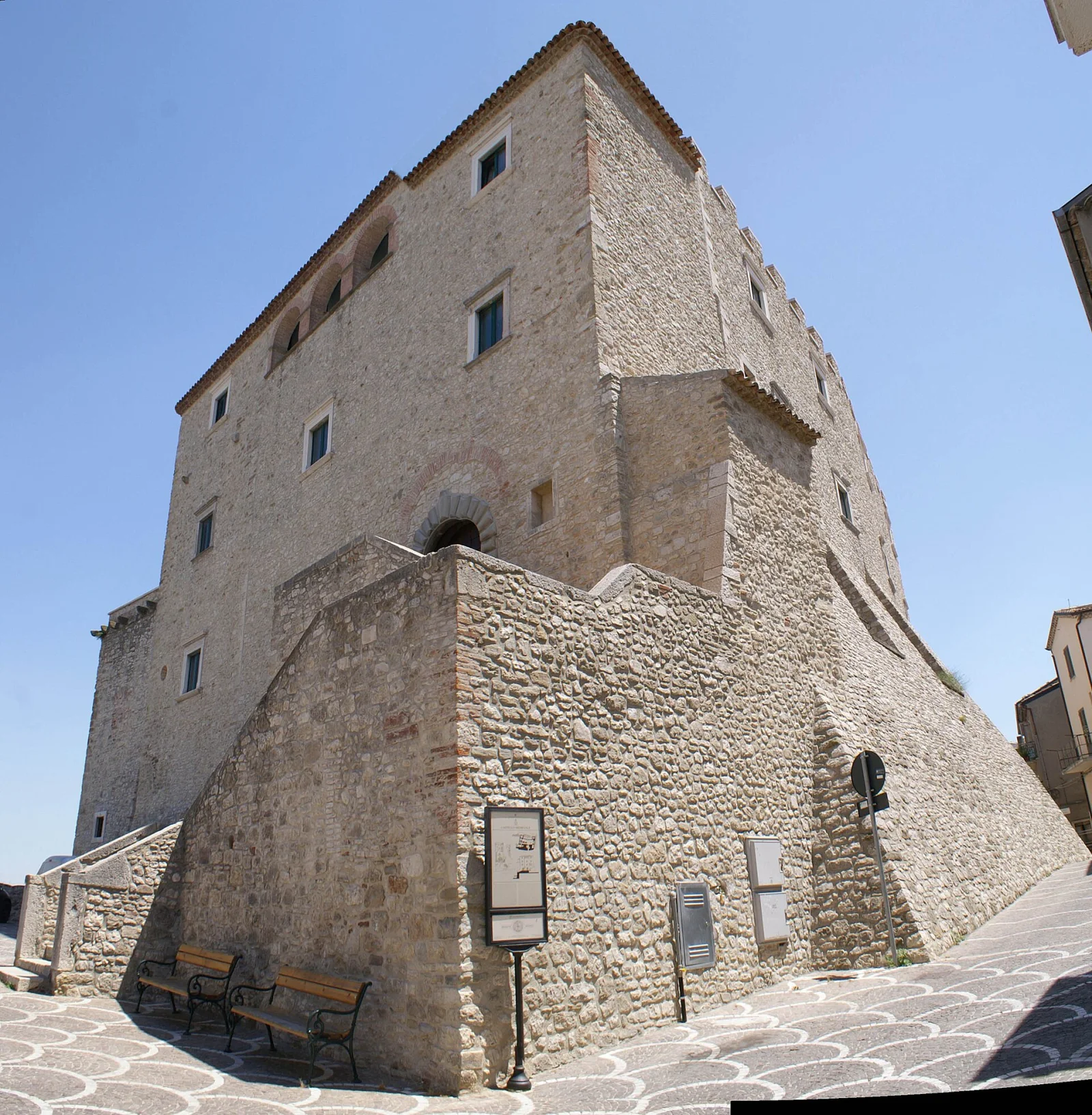
Look at the building from outside before going in: it states its two ages without any transition. On the south-west side stands the square medieval mass with its Guelph merlons, to the north-east the corner towers; on the north-west front, the rusticated portal, the windows and the little loggia of three round arches belong to the Renaissance rebuilding. It began as a bastion on the Serrone hill, watching the Tappino valley from a border district between Molise and Puglia; it was the di Capua, who bought it in 1484, who pulled down much of the military fabric to make a palace of it.