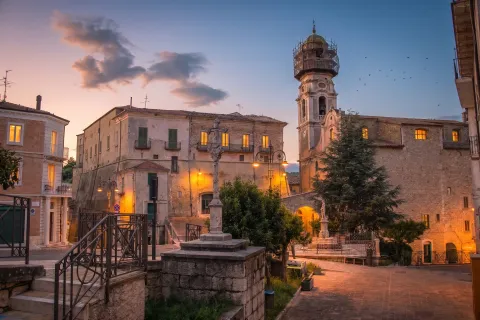
The baptismal font that now fills a public fountain in Sant'Elia a Pianisi did not start out there. It came from the church of Santa Maria in Planisi, which stood on the hill northwest of the village, inside the castle enclosure. When the archbishop of Benevento Vincenzo Maria Orsini, the future Pope Benedict XIII, deconsecrated it in 1701, the settlement had long been abandoned, and whatever could still be used was carried down to the valley.
The castle appears in documents from 1008, although the charter that first names it is in fact a later forgery. Firm evidence arrives with the Angevins: in the chancery registers the Castrum Pianisii is valued at thirty gold ounces, and in 1269 it is held by Jean de Nanteuil, to whom the inhabitants paid the levy known as the colletta pro indumentis. Then the sources fall silent. Some date the end to the earthquake of 1306, others push it into the sixteenth century; local tradition prefers 1598 and blames the Spanish.
What to see
What is visible today was brought back by three excavation campaigns run by the University of Molise between 2013 and 2015. Long stretches of the retaining walls of the upper terrace have emerged, along with the base of the cylindrical tower that once loomed over the settlement and the remains of the church, with its wide apse and a solid bell tower. Look closely at the blocks: regular, almost free of tooling marks, because the stone was split along the natural fissures of the quarry. It is a soft limestone, and in several places it flakes away on its own. The collapse layers yielded numerous roof tiles, a coin of the Byzantine emperor Romanos I Lekapenos and the bases of protomaiolica cups.
Our editors' tip
The hill lies just under four kilometres northwest of the village: closed shoes, no shade, and the climb only makes sense in full daylight. Before or after, take the short circuit through the village itself: the font in the fountain, the thirteenth-century relief set into the façade of the church of San Rocco and, in San Pietro, the late fourteenth-century fresco of a knight fighting a winged dragon, identified here with Jean de Nanteuil himself.