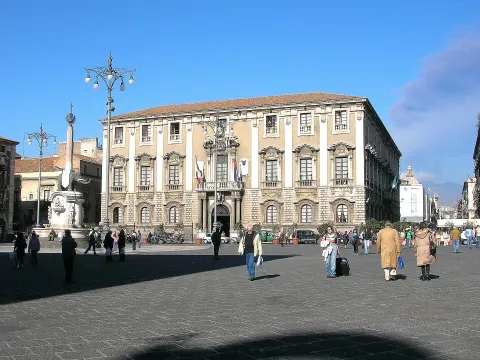
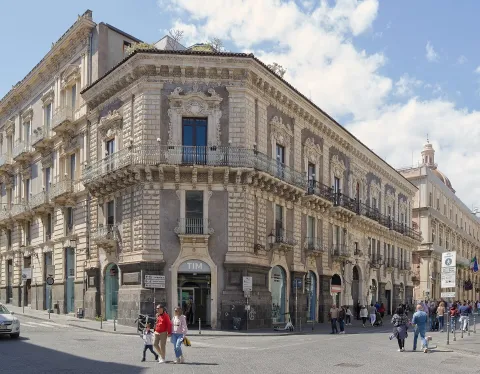
Behind the façade of this palace, in the middle of the most photographed street of Catanese baroque, there is a hanging garden: the second largest in the city. It is not a terrace with a few pots, it is a garden lifted off the ground, and it has been there for three centuries without almost any of the people passing beneath knowing they have it over their heads.
What to see
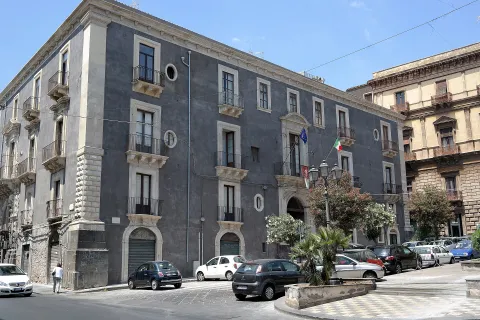
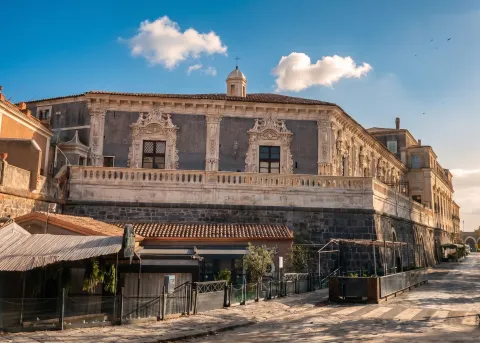
The palace, today Asmundo Francica-Nava, was built at the beginning of the eighteenth century in the heart of baroque Catania, within the plan for rebuilding the city after the earthquake of 1693. It is attributed to Giovanni Battista Vaccarini: attributed, not signed, and it is worth saying so because in Catania many eighteenth-century things carry his name by tradition rather than by document. The main façade, the one seen from via dei Crociferi, has two floors and a wide portal flanked by columns on which the central balcony rests, surmounted by the family arms. Inside, the building develops in a central body around a courtyard and in a side wing, and it is this wing that carries the hanging garden. The interiors preserve the rococo style intact.
You reach the palace from piazza Asmundo di Gisira, and there are two ways: from via dei Crociferi by taking via San Benedetto, the small side street that opens between the church of San Benedetto and that of San Francesco Borgia, or from via Teatro Greco by way of via Ospizio di Beneficenza. The double surname comes from the family that succeeded the Asmundo: here, in 1928, the archbishop of Catania Giuseppe Francica Nava di Bondifè died.
Visiting
It is a private palace. No regular opening to the public is recorded, so the hanging garden and the rococo rooms stay out of reach except on particular occasions, which have to be checked each time. What is always visible is the front from via dei Crociferi and the small square it faces. A quarter of an hour.
Our editors' tip
Take via San Benedetto and walk the whole of it, instead of staying on via dei Crociferi photographing the façades. It is a narrow side street, wedged between two churches, and in thirty paces you pass from the street the eighteenth century built to be looked at to the one it built to be used. It is the quickest way to understand how a baroque quarter really works: the display in front, the service lanes behind, and the hidden gardens in between, raised where nobody looks for them.