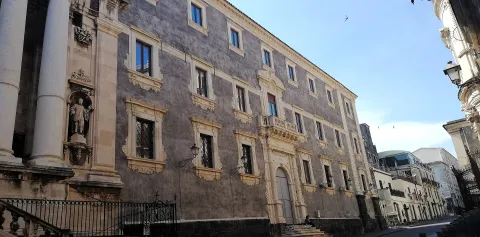
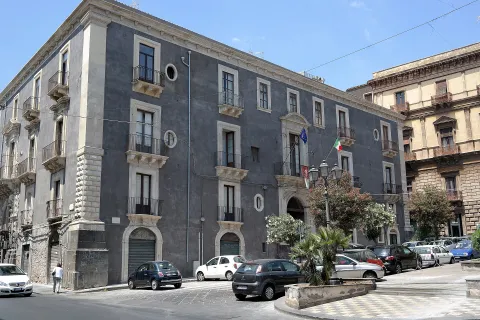
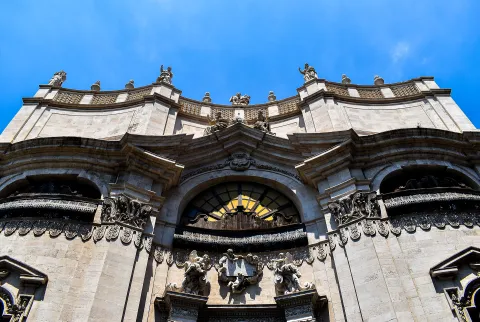
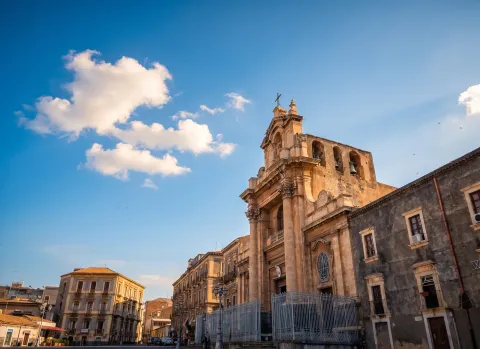
First founded outside Catania's walls in 1334 by Rugieri la Matina and Alemanna Lumello, this Benedictine convent moved in the 15th century to the site of an ancient temple of Aesculapius. The entire complex was destroyed by the 1693 Val di Noto earthquake, with only five nuns surviving. Rebuilt between 1704 and 1763 with a facade designed by Giovanni Battista Vaccarini, the church anchors Via dei Crociferi. The convent buildings on either side of the street are connected by the Benedictine Arch, erected in 1704 and famed in local lore for allegedly being built in a single night to circumvent municipal opposition.
What to see
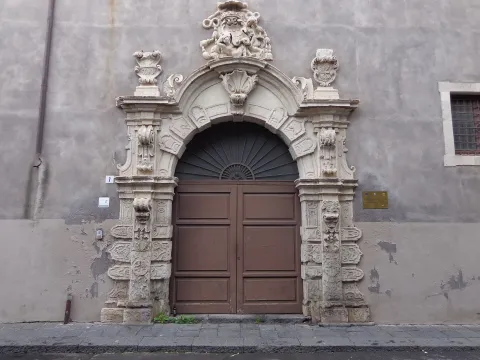
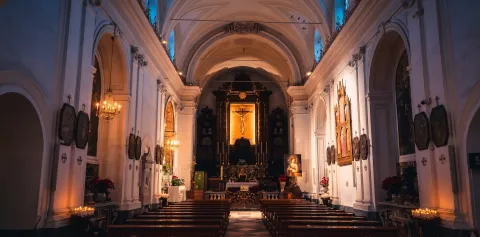
Visitors approach the entrance via the Angel's Staircase, a marble flight flanked by statues of angels and framed by a wrought-iron fence. Vaccarini's tall facade features a wooden portal carved with scenes from the life of St. Benedict (bearing the date 1747 on its keystone), a broken pediment with allegorical figures of Fortitude and Temperance, and a statue of the Virgin Mary above. Inside, the single nave is crowned by a vault painted by Giovanni Tuccari between 1726 and 1729 depicting the Life and Triumph of St. Benedict. These frescoes, concealed under plaster for decades, re-emerged after World War II bombing in 1943 and were restored under Armando Dillon. Works in the right nave include the Immaculate Conception by Sebastiano Lo Monaco, fragments of the Martyrdom of St. Placidus, King Totila Before St. Benedict by Michele Rapisardi, and a canvas by Guglielmo Borremans. The left nave contains Tobias and the Angel by Matteo Desiderato (1780), an anonymous 1726 Martyrdom of St. Agatha, and a 1685 crucifix attributed to Giulio Gallo. The 1789 high altar by Giovanni Petrosino features polychrome marble, Sicilian jasper, silver reliefs of the Last Supper, and a tabernacle door depicting King David playing the lyre.
Visiting
A guided visitor route established in April 2013 grants access to the church interior, the Angel's Staircase, the 18th-century cloistered parlour, and the excavated remains of an ancient Roman domus. The monastic site also houses the San Benedetto educational institute, founded in the late 19th century by Archbishop Giuseppe Francica Nava di Bondifè, while the Badia Piccola wing hosts the Museum of Contemporary Art of Sicily.
Our editors' tip
Take time to examine the fine silverwork on the high altar tabernacle showing King David with his lyre, and make sure to view the excavated Roman domus beneath the complex.