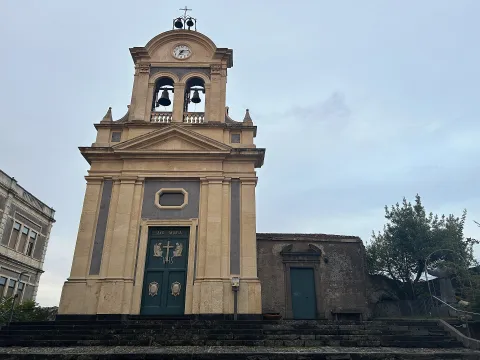
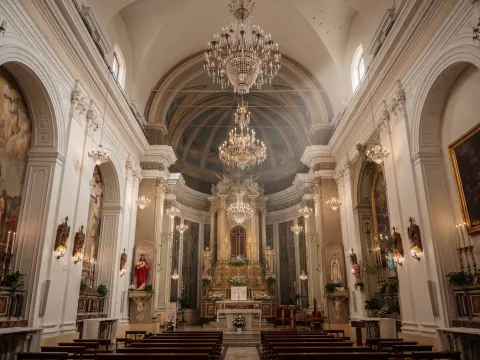
Dedicated to local historian Monsignor Gaetano Savasta, the civic museum of Paternò occupies two restored 19th-century buildings: the former Bourbon prison and the former municipal slaughterhouse. The collection documents the area's history from antiquity to traditional rural trades.
What to see
The museum is divided into two separate thematic sections. The archaeological section is housed in the former Bourbon prison on Piazza Martiri d'Ungheria, a rectangular early 19th-century structure featuring a main entrance with a round arch framed in Etna lava stone, lowered-arch windows, and heavy iron bars. Inside, visitors can view Roman and medieval artifacts, including amphorae, pottery sherds, and plates recovered during excavations conducted on Paternò hill between 1993 and 1998 across the areas of Poggio Monaco, San Marco, Poggio Cocola, and Monte Castellaccio. The ethno-anthropological section is located in the former municipal slaughterhouse in the Acquagrassa district, erected following an 1835 municipal decree banning public livestock slaughter and active until the 1970s. This location displays tools, implements, and equipment from traditional agricultural work and historic crafts.
Visiting
A visit to the museum offers access to two repurposed civic spaces: the former prison, used until the post-World War II period for short-term sentences and briefly as the town library between 1997 and 2001 before opening as a museum on December 8, 2007; and the former slaughterhouse, renovated from 2005 onward and inaugurated in 2009 as a rural heritage museum.
Our editors' tip
When visiting the former Bourbon prison, take time to examine the main doorway on Piazza Martiri d'Ungheria to see how local dark lava stone was used to construct its full-centered arch frame.