Located in Piazza Dante, the Church of San Nicolò l'Arena is the largest place of worship in Sicily, covering over 1,500 square metres with a central dome reaching 66 metres in height. Its history links back to 1150, when Benedictine monks established a monastery in Nicolosi before moving to Catania. The present building replaced a 1578 Renaissance church destroyed by the 1669 eruption of Mount Etna. Reconstruction started in 1687 to a design by Roman architect Giovanni Battista Contini, who drew inspiration from St. Peter's Basilica in Rome to host large assemblies during religious rites like the September procession of the Holy Nail. Interrupted by the 1693 earthquake, construction resumed in 1730 under architects Andrea and Antonio Amato, Francesco Battaglia, Stefano Ittar — who raised the dome in 1780 — and Carmelo Battaglia Santangelo.
What to see
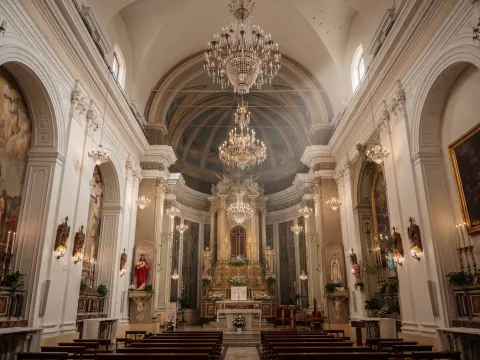
The interior follows a Latin cross plan with three aisles divided by large arches under equal-height vaults, illuminated by high windows and crowned by Ittar's 62-metre-high inner dome. An elevated deep choir contains the monks' seating, while marble-lined side chapels preserve altarpieces by non-Sicilian painters active in Rome, including Bernardino Nocchi, Stefano Tofanelli, Vincenzo Camuccini, Mariano Rossi, and Ferdinando Boudard. The sacristy, designed by Francesco Battaglia, features 18th-century wooden stalls and frescoes by Giovan Battista Piparo. Outside, the facade on Piazza Dante features eight massive free-standing columns left unfinished at mid-height, framing three grand portals and balustraded windows.
Visiting
Confiscated by the state in 1866 and damaged by bombing during the Second World War, the church was later reconsecrated and returned to the Benedictine order in 1989. Rooms behind the main apse house Catania's Municipal Military Shrine, commemorating First World War soldiers with frescoes by Alessandro Abate. The dome underwent extensive structural restoration completed in 2012.
Our editors' tip
Look closely at the unfinished facade on Piazza Dante to spot architect Carmelo Battaglia Santangelo's signature dated 1796 on the central window frame.