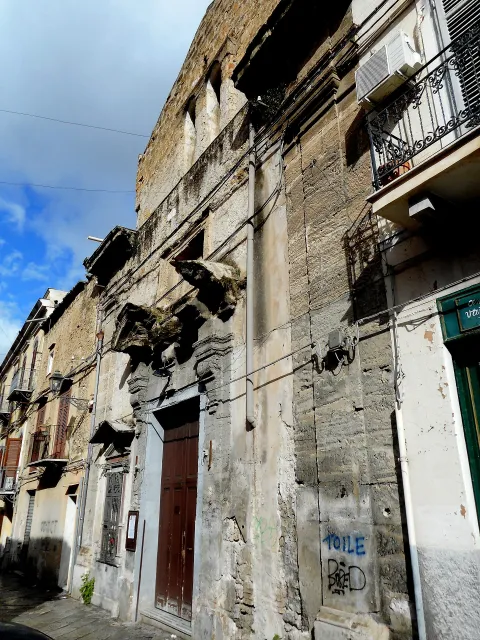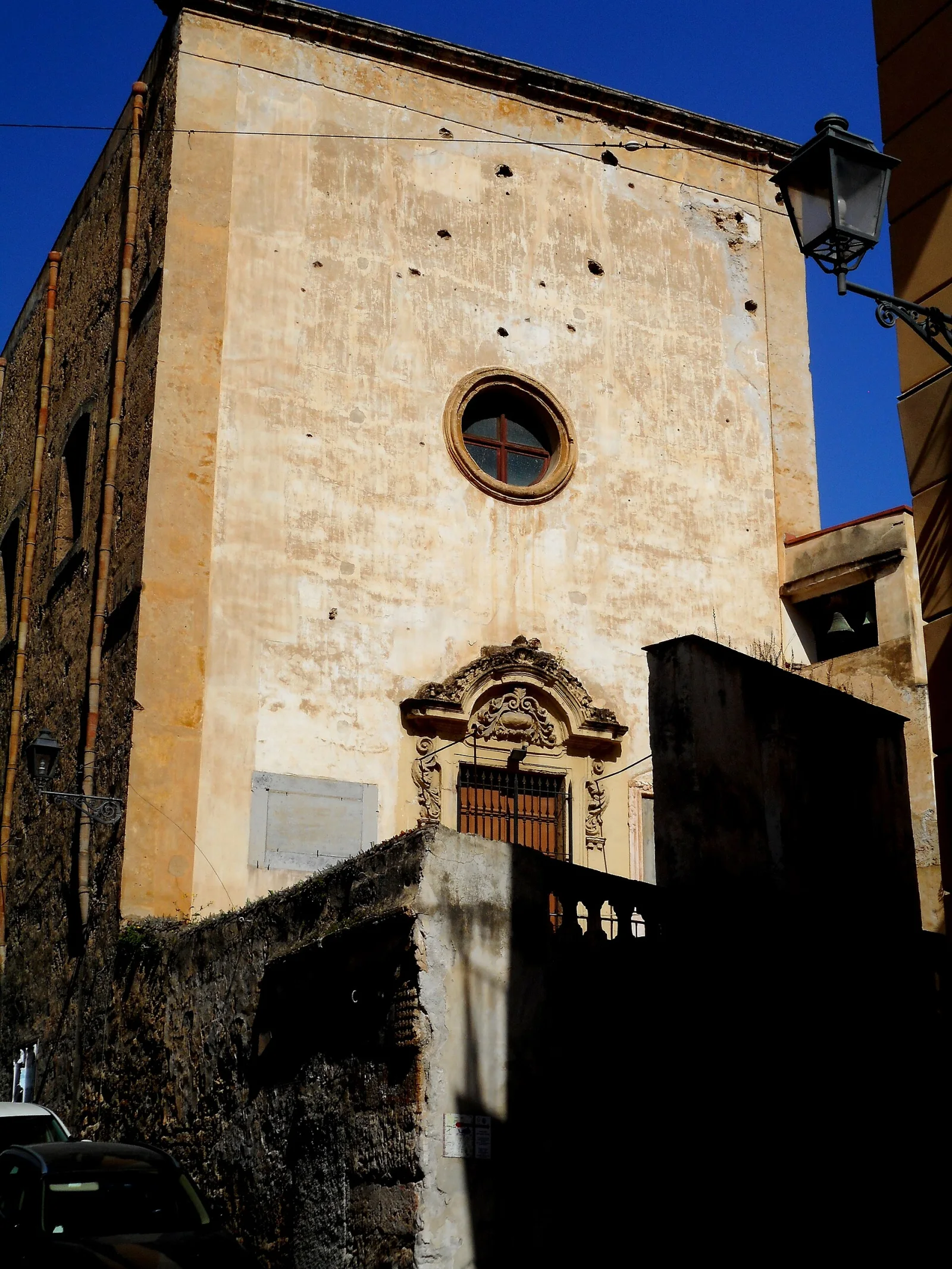
This church was built on top of itself. The confreres had made a small one, then decided they wanted a bigger one and raised it on the floor above, turning the first into a crypt: which is why from the street you see two flights of steps climbing and meeting at the entrance, and below, behind a gate, a large vaulted room that is the old church.
What to see
The owner is the Congregation of the Holy Guardian Angel, which everyone in Palermo called the footmen's: the servants who stood on the back of noble carriages. Founded in 1699, it had first found room in the church of the Madonna delle Raccomandate and then in that of the Madonna dell'Itria alla Ferraria, two buildings that no longer exist; at the start of the eighteenth century the confreres built their own church in the Papireto district, opened to the public on the eighth of July 1701. The look of the building is post-baroque, the hall has a single nave and five altars, and at the entrance there is a wooden singers' gallery halfway between rococo and neoclassical.
On the high altar is the Guardian Angel painted by the Sicilian Michelangelo Cimino. On the left open the chapel of the Virgin, with the Madonna of the footmen by Gioacchino Martorana, and those of saint Agatha and of Ignatius of Loyola; on the right the wooden Crucifix, with the Sorrowful Triad painted on the wall beneath the sculpture, saint Peter freed by the angel, and saint Michael the archangel, who has below him a wax statue of the Assumption. In the sacristy is a painting on slate of the Madonna of Trapani between saint Joseph and saint Rosalia. The congregation was recognised as a legal person in 1998, and the church often hosts classical concerts, organised with the Alessandro Scarlatti conservatory.
Visiting
It stands at the corner of via Matteo Bonello and via dei Carrettieri, near the cathedral. It is not a parish with fixed hours: it opens for the congregation's services and for concerts, and the music calendar is often the simplest way to get inside. Worth asking first. Twenty minutes.
Our editors' tip
Go round the altars reading the dedications, and then look at the paintings. Some sources hold that the saint Agatha in prison in fact shows Hagar, Abraham's slave, and that the Ignatius of Loyola is in fact a saint Cajetan. Neither painting has a certain author. This is a church where at least two altars may be dedicated to one person and show another, and when you are visiting a hundred churches in a row it is a useful reminder: the label is not a source.