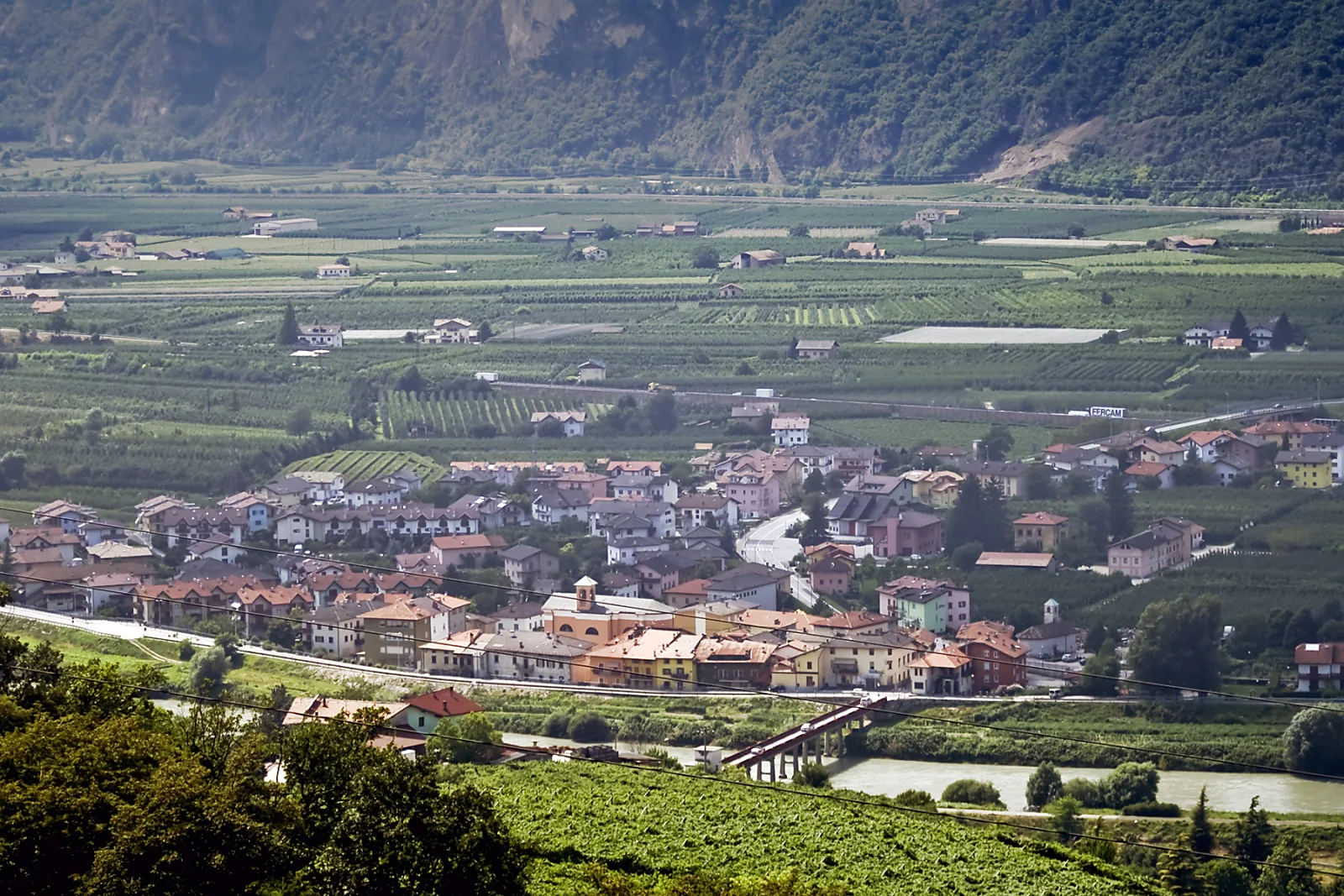
Terre d'Adige came into being on the first of January 2019 from the merger of Zambana and Nave San Rocco, approved by the citizens in the referendum of 2016 — but the two villages had already been a single comune once, and not by their own choice: in 1928 Nave San Rocco was suppressed and joined to Zambana together with Fai, and in 1948 both were detached and re-established. What the fascist reorganisation had imposed and the Republic had undone, the two villages voted for themselves seventy years later. The name they chose belongs to neither of them: it is the name of the land and of the river. And for its first years the comune had no coat of arms, because the one proposed by the council was approved by the provincial government only in 2023.
Zambana, which is the seat of the comune, is not where it used to be. On the seventh of September 1955 an enormous mass of rock and debris broke away from the flank of the Paganella; in November a hanging spur slid down as far as the streams above the village, a second one stayed poised, and the president of the province ordered the evacuation. In March 1956 a second landslide broke through the dam that had been raised along the Maor and reached the houses; on the sixteenth of April, after a day of torrential rain, another slide came down the val Manara and buried the last dwellings left standing. The village was declared uninhabitable, and in 1957 a decree of the president of the Republic began the building of a new Zambana, on the plain beyond the Adige. Of the old one there remains the church of Santi Filippo e Giacomo, standing behind an embankment more than seven metres thick, raised to protect what was left. In 1993 the old site became habitable again.
Straight-line distances from the town centre. Tap a point to open its page.
Near Terre d'Adige
The closest destinations covered by our editors, with straight-line distance.


Places to see within 25 km
Outside Terre d'Adige, but an easy day trip away.