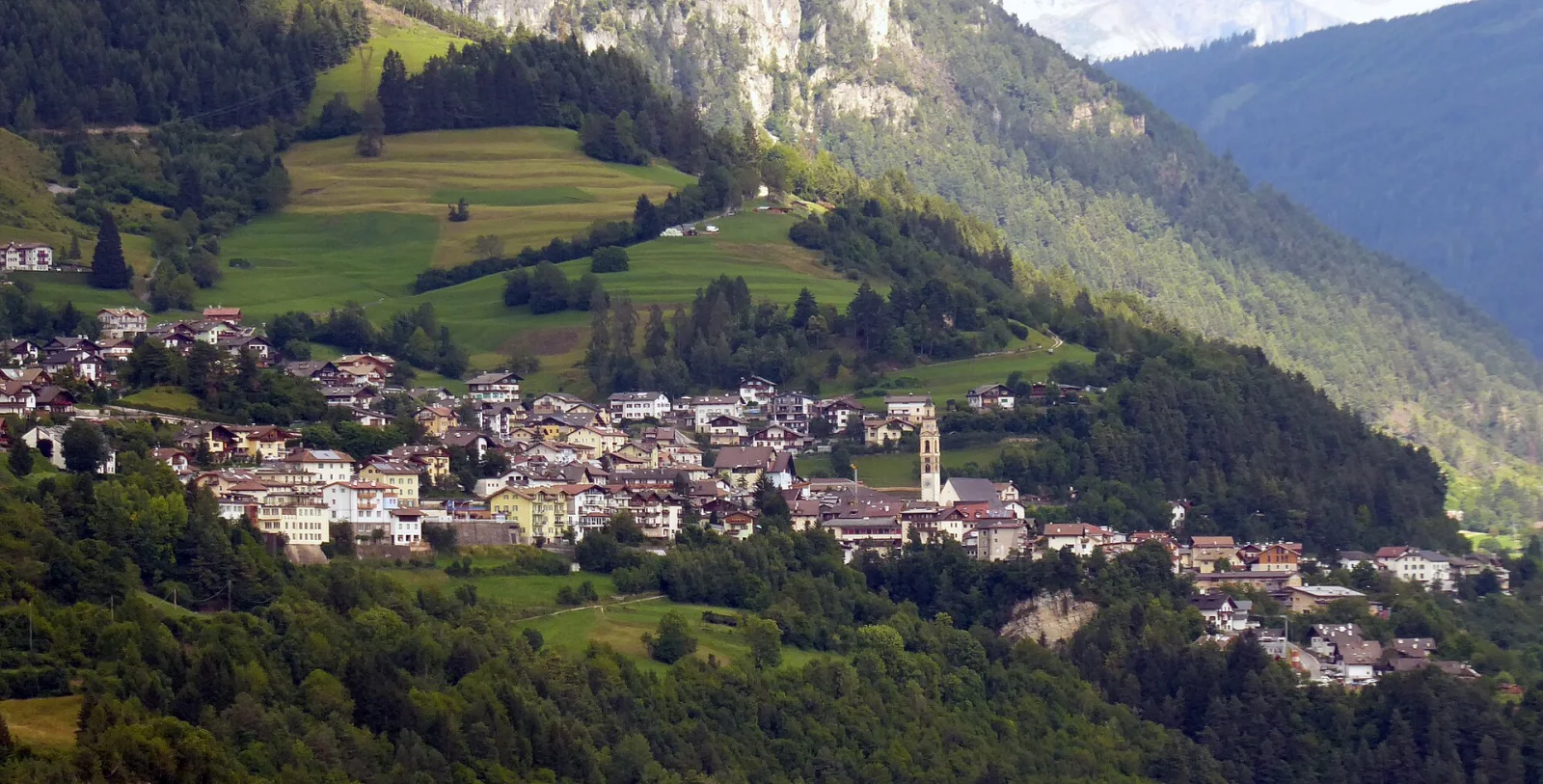
Tesero is one of the historic quarters of the Magnifica Comunità di Fiemme, the self-governing institution born of the Ghebardine pacts of the twelfth century, which administered woods and pastures on behalf of those who lived among them. It lasted a long time: it was Napoleon, in 1807, who brought the valley into the area administered by Bavaria, abolished the local Regole and instituted the comuni. The village has largely kept its medieval structure, with houses whose wooden balconies run in two or three tiers, crucifixes on the façades and roofs covered with shingles. And above all it has kept a trade: here they work wood, they carve and they sculpt, and they build musical instruments — pianos, organs, lutes, guitars — because not far off lies the forest of Paneveggio, which they call the forest of the violins for the quality of its spruces.
The other story of the village is that of water. From the middle of the nineteenth century the rio Stava drove everything: a large drying house for conifer seeds opened in 1855, two paper mills, three forges, mills and sawmills; in 1907 the comune built itself a power station, with a penstock of seventy-five metres of head, which brought light to the hamlets of Lago and Stava as well. Above those same waters, on Monte Prestavel, stood a mining plant with its settling basins. On the nineteenth of July 1985 the embankment of one of those basins gave way, and the flow of mud came down on the settlement of Stava and on via Mulini, killing two hundred and sixty-eight people. In the hamlet there is now a documentation centre that keeps the memory of that day.