The main theatre of Padua was born as a private venture: a company of Paduan nobles commissioned it, wanting a hall of their own, and it opened in 1751 with a melodrama by Metastasio. It was called the New Theatre of the Nobility, and the composer's name it bears today was given much later, when the hall was rebuilt.
What to see
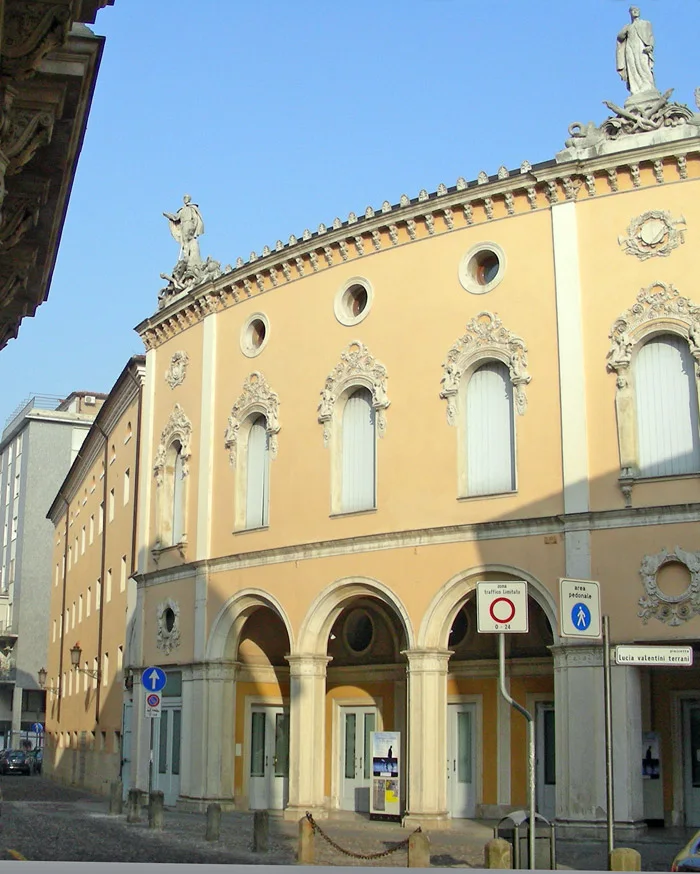
The exterior was rearranged in the middle of the nineteenth century to a design by Giuseppe Jappelli, the architect who left Padua the Pedrocchi café. The interior, instead, is of 1884, the work of the Milanese architect who had designed the Rome opera house: stalls, tiers of boxes and the vault with the Dance of the Hours, painted and then redone by a second artist.
The reopening, under the new name, was accompanied by music written by a Paduan composer. Today the theatre is the operational seat of the Veneto's public theatre company and hosts the final year of the city's drama academy: it is a building better visited as a spectator, because the hall makes sense when it is full and the lights are down.
Visiting
The theatre is in via dei Livello, at the corner of corso Milano, ten minutes on foot from the basilica of the Saint and from the Pedrocchi; you go in with a ticket for the performances, while guided visits to the hall are occasional and must be looked for in the programme. Two hours for a show.
Our editors' tip
Walk round the side along the avenue and look up: there are three large pointed windows, opened to light the stage. Nobody saw them for two centuries, because houses were built against them; they reappeared in 1958, when those were demolished to open the road. A building can hide its own finest front.