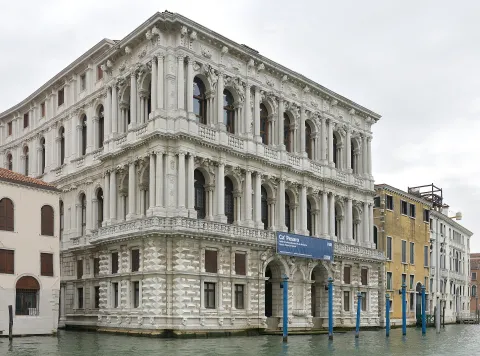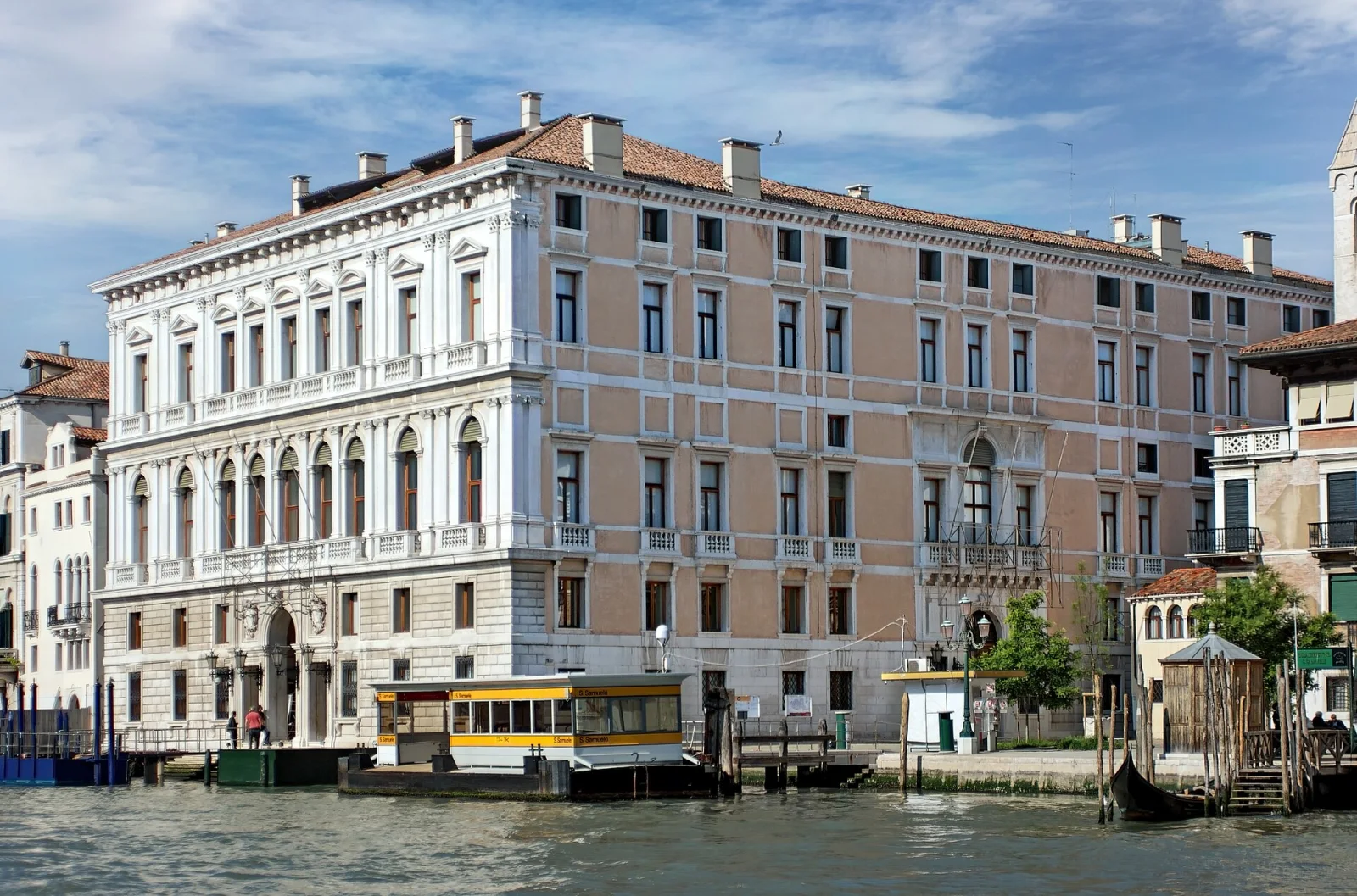
It is the last palace a patrician family built on the Grand Canal before the Republic ended, and the largest: the Grassi, rich and new, bought house after house at San Samuele and from 1748 had Giorgio Massari, who was finishing Ca' Rezzonico on the opposite bank, raise a white stone façade in classical style that among the Gothic and Baroque ones looks as if it had arrived from Rome. Inside there is no Venetian portego but a colonnaded courtyard, a frescoed staircase and painted ceilings. Then the Grassi died out and the palace changed hands ten times, until Gianni Agnelli's Fiat in 1983, which with Gae Aulenti made it the seat of great exhibitions, and François Pinault, who bought it in 2005 to house his collection of contemporary art.
What to see
What there is depends on the exhibition: Palazzo Grassi has no permanent collection on show, but one or two exhibitions a year from the Pinault Collection, one of the largest in the world of the art of the present, with artists from Rudolf Stingel to Damien Hirst, who in 2017 filled the palace with fake treasures pulled up from a fake wreck. Those who come for the palace find in any case the central courtyard covered by a velarium, where every exhibition puts its biggest piece, the staircase with frescoes by Michelangelo Morlaiter and Francesco Zanchi, the ceilings by Giambattista Canal.
And they find the work of Tadao Ando, who in the restoration chose to be invisible: white marmorino walls, grey linoleum floors over the old marbles, light from above, an almost monastic neutrality that lets the works and the windows on the Grand Canal speak. Next door, in the Grassi garden, the Teatrino, the concrete auditorium Ando made out of the old open-air theatre of the nineteen-fifties; and one vaporetto stop away, at Punta della Dogana, the other half of the collection, in the sea customs house by the same architect.
Visiting
The palace is on Campo San Samuele, San Samuele vaporetto stop on the Grand Canal, ten minutes from San Marco through the calli; its own ticket, combinable with Punta della Dogana, closed on Tuesdays and closed altogether between one exhibition and the next, usually in winter: check the calendar first. Two hours, more with the Dogana. The Teatrino has a programme of talks and screenings, often free.
Our editors' tip
Buy the ticket even if the exhibition does not interest you: go up to the second floor and lean out of the central windows over the Grand Canal, facing Ca' Rezzonico, in the afternoon light, and you will have the view the Grassi paid to have and that no other palace open to the public gives from this height. Then walk round the courtyard from above and look at the big piece from every side.