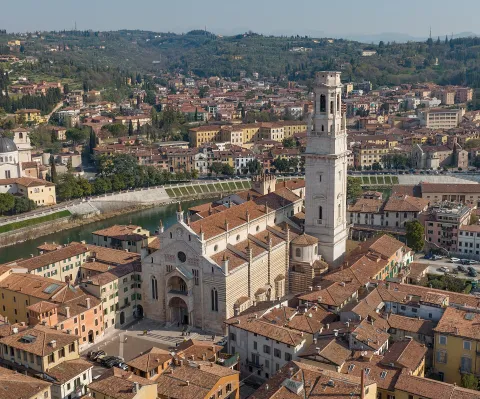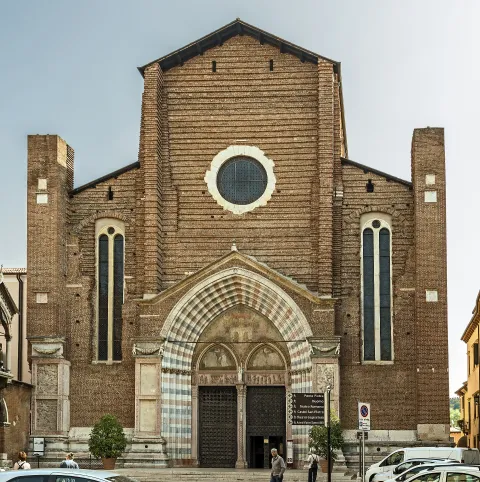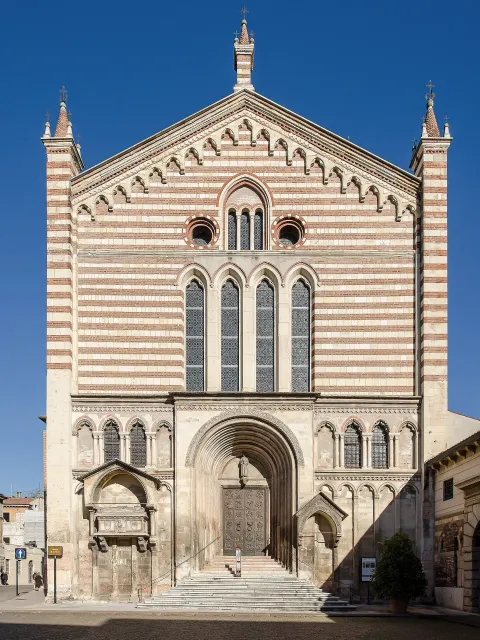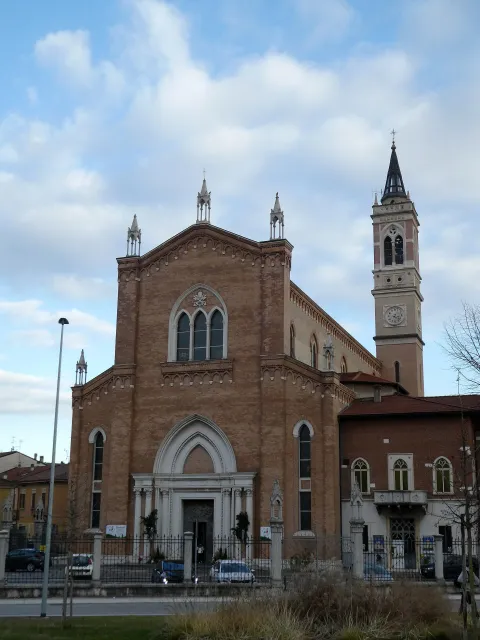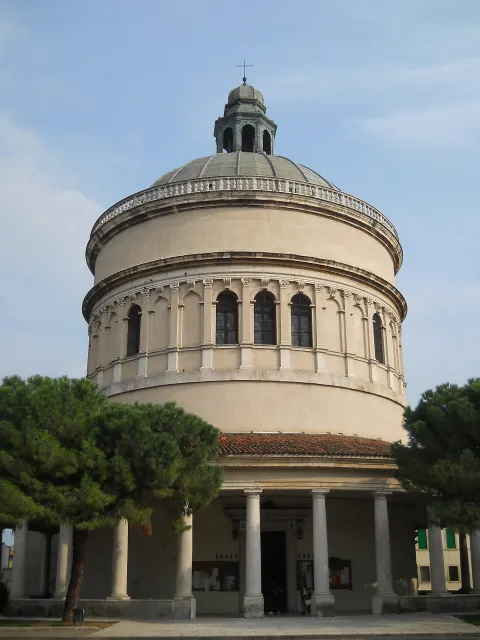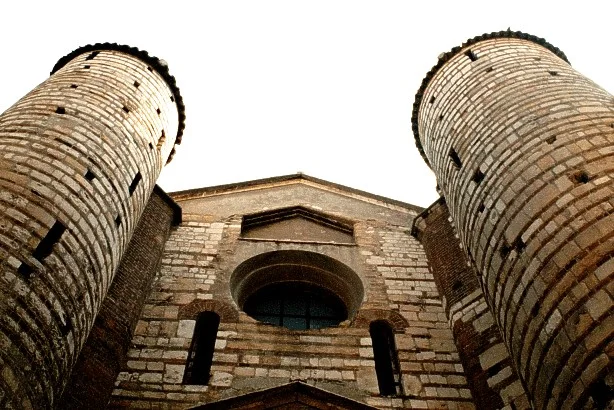
Between Corso Cavour and the Adige, in the heart of Verona's historic centre, the church of San Lorenzo stands on the site of a much older place of worship, of which only a few fragments survive, built into the present-day structure.
What to see
The 12th-century building seen today grew out of works probably begun in 1110, soon interrupted — perhaps because of the 1117 earthquake — and later resumed with a different building technique, the alternating courses of brick and tufa blocks that still define the façade. Restorations carried out in the late 19th century uncovered a lead plaque recording that, in that same year of 1110, Bishop Zufeto placed there the relics of the blessed Ippolito.
The two cylindrical stair towers flanking the façade, left without any crowning as if never finished, echo a model widespread among French Cluniac abbeys; inside, among the surviving 13th- and 14th-century frescoes, the 16th-century altarpiece by Domenico Brusasorzi stands out on the high altar. Restoration work carried out in the late 19th century and after the Second World War stripped away Baroque and Neoclassical additions to restore the church's Romanesque appearance, also demolishing an oratory built in 1824, of which only four Corinthian columns survive.
Visiting
The church is generally open during hours of worship; for events or exceptional closures it is worth checking with the Diocese of Verona.
Our editors' tip
It's worth taking a close look at the alternating brickwork of brick and river pebbles or tufa: it's the same Romanesque technique found in Verona's other monuments, and here it reads almost like an open-air manual.