Patron saint festival
Feast of Saint Justina
📅 Every year, on 7 October
On 7 October Roana celebrates its patron Saint Justina; the town is also a center of Cimbrian culture, with the Hoga Zait festival since 2006 and a dedicated museum.
Roana is a scattered comune, with its seat at Canove, and one of the last islands of the Cimbrian language, the Germanic speech brought up onto the plateau in the Middle Ages by people from the Bavarian lands. Today about ten elderly people still use Cimbrian, above all at Mezzaselva, but many words survive in local turns of phrase and in place names, and plenty of people feel themselves Cimbri without being able to speak it; the Institute of Cimbrian Culture looks after it. The name of the village appears in 983 as Rauna and remains disputed: in Cimbrian it sounds Robàan, which is enough to rule out a Germanic origin.
On Monte Verena, above the village, stood the fort from which the shell was fired that took Italy into the war. Then the war came back: from 25 June 1916 until the end of the fighting the front line cut the comune in two along the Assa torrent, with Mezzaselva, Roana and Camporovere immediately behind the imperial front and Treschè Conca, Canove and Cesuna on the Italian side. The bridge of 1906 over the Val d'Assa, which holds the villages together above a valley floor carved with ancient rock figures, was destroyed and rebuilt. The coat of arms of 1974 puts together an R and three Cs: Roana, Canove, Cesuna, Camporovere.
No events match these filters.
📅 Every year, on 7 October
On 7 October Roana celebrates its patron Saint Justina; the town is also a center of Cimbrian culture, with the Hoga Zait festival since 2006 and a dedicated museum.
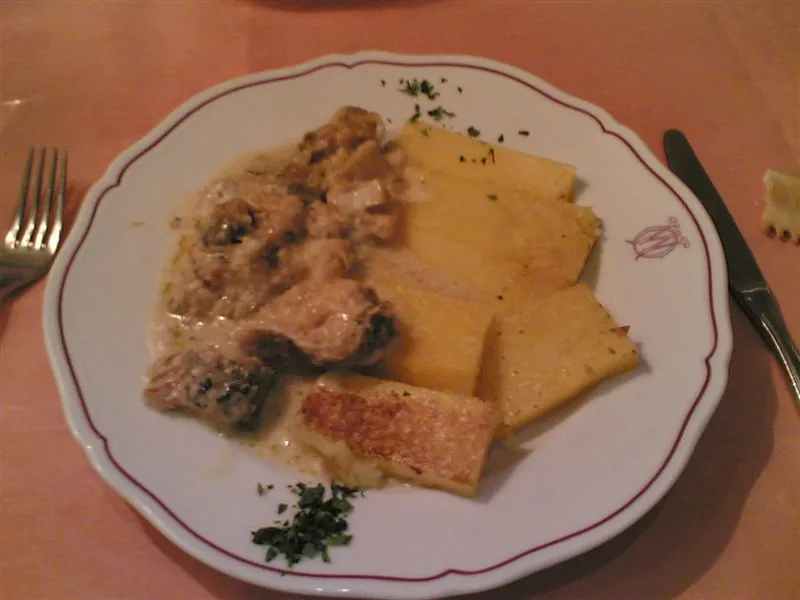
Stockfish, milk, oil and anchovies, cooked for hours over the lowest heat: baccalà alla vicentina arrived from Norway with a shipwreck in 1432.
Read more →Straight-line distances from the town centre. Tap a point to open its page.
The closest destinations covered by our editors, with straight-line distance.
Outside Roana, but an easy day trip away.