
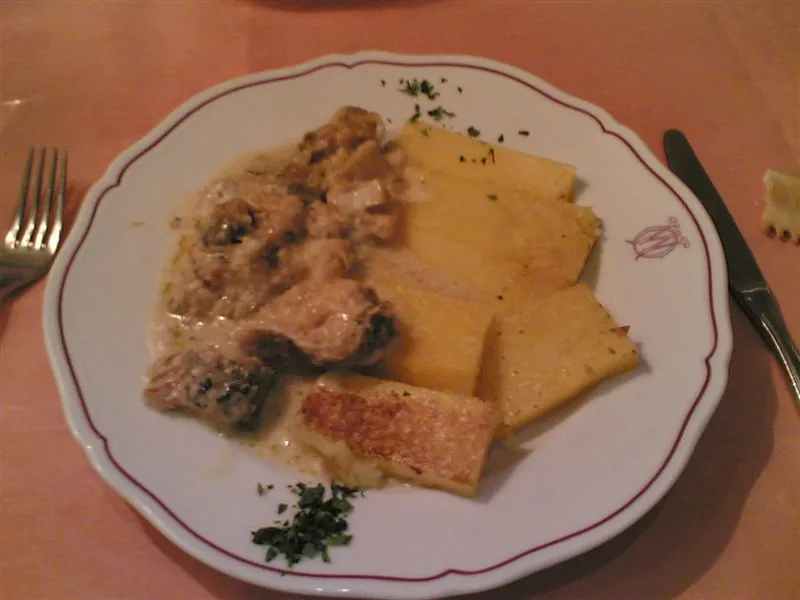
Baccalà alla Vicentina stockfish slow-cooked with milk, oil and anchovies
Stockfish, milk, oil and anchovies, cooked for hours over the lowest heat: baccalà alla vicentina arrived from Norway with a shipwreck in 1432.
Read more →Rotzo lies at the western end of the plateau of the Seven Communes, between the Val d'Assa and the Val d'Astico. The name appears from 1175 and comes from rozzo, which in old Vicentine meant a group of houses: the Germanic personal name Rozzo is ruled out, because the place name is older than the arrival of the Cimbri, who nevertheless call the village Rotz. At Bostel, near Castelletto, lies one of the most important archaeological sites of the plateau: a permanent village of the second Iron Age, already excavated in the middle of the eighteenth century by the abbot Agostino Dal Pozzo, who brought to light more than forty small houses of dry-stone walling, each with a single room, the entrance facing west and in the middle a round pit for cooking.
In 1598 the inspector of the plateau, Francesco Caldogno, sent the doge a report describing Rotzo thus: a place neither very large nor beautiful, but most thriving, thanks to its mild climate and its nearness to the plain, which let its inhabitants trade. Three centuries later the Great War took everything: families had to leave their homes and spent the war years as refugees at Barbarano Vicentino and at Stradella, in the province of Pavia; the church of Santa Gertrude was levelled, and the one seen today, neo-Gothic, is of 1938. In the territory the Campolongo fort remains.
Stockfish, milk, oil and anchovies, cooked for hours over the lowest heat: baccalà alla vicentina arrived from Norway with a shipwreck in 1432.
Read more →Straight-line distances from the town centre. Tap a point to open its page.
The closest destinations covered by our editors, with straight-line distance.
Outside Rotzo, but an easy day trip away.


