Patron saint festival
Feast of Saint Matthew the Apostle
📅 Every year, on 21 September
On 21 September Asiago celebrates Saint Matthew the Apostle; the people of the Plateau are still united by Cimbrian customs, of Germanic origin.
In 1310 the seven municipalities of the plateau gave themselves a common government, the Spettabile Reggenza dei Sette Comuni, with a militia of their own: it was one of the earliest self-governing federations in Europe, and Asiago was its capital. It remained a separate land until 1807, when the French abolished its sovereignty and independence. The name, on the other hand, is not Germanic as it looks: it appears in 1204 as Axiglagum and is a Latin estate name, from an Asellius or an Acilius; the Cimbrian form Slege is only an adaptation of it, and the etymology that would derive it from the German for wood-cutting has no foundation. Then came the war: after the Spring Offensive Asiago found itself in no man's land, shelled by the Austro-Hungarian artillery and by the Italian, and it was completely razed. They rebuilt it as soon as the fighting stopped, and on the Leiten hill an ossuary gathers the fallen of three years of combat.
Asiago lies at around a thousand metres and is one of the coldest inhabited places in the Alps: the official record is thirty-one degrees below zero, recorded on 22 and 23 January 1942. It is also the reason the University of Padua put its observatories here, which are the main Italian centre of optical astronomy. The one on the Pennar hill opened in that same 1942 with what was then the largest telescope in Europe, a hundred and twenty-two centimetre reflector named after Galileo; the station on Cima Ekar opened in 1973 with the Niccolò Copernico, of a hundred and eighty-two centimetres, the largest optical instrument on Italian soil. In 1996 the astronomers of Padua gave the name Asiago to asteroid number 7679.
No events match these filters.
📅 Every year, on 21 September
On 21 September Asiago celebrates Saint Matthew the Apostle; the people of the Plateau are still united by Cimbrian customs, of Germanic origin.
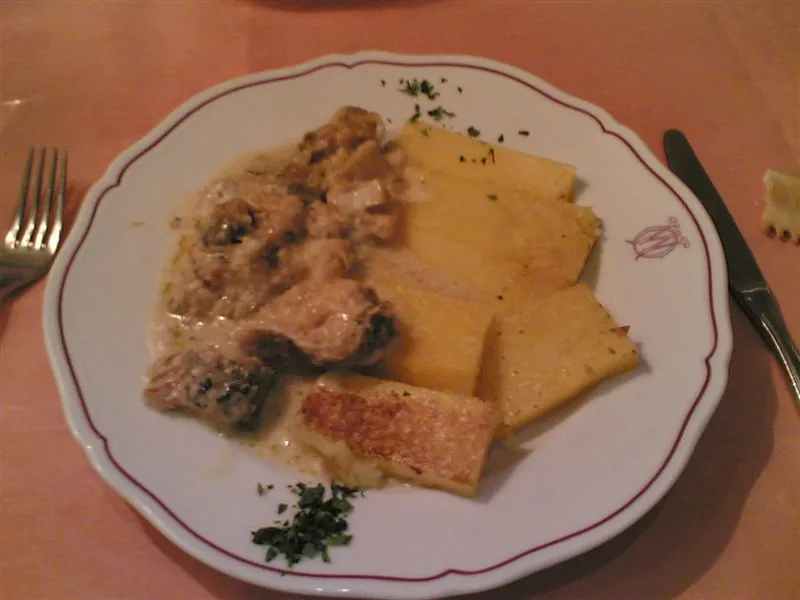
Stockfish, milk, oil and anchovies, cooked for hours over the lowest heat: baccalà alla vicentina arrived from Norway with a shipwreck in 1432.
Read more →Straight-line distances from the town centre. Tap a point to open its page.
The closest destinations covered by our editors, with straight-line distance.
Outside Asiago, but an easy day trip away.