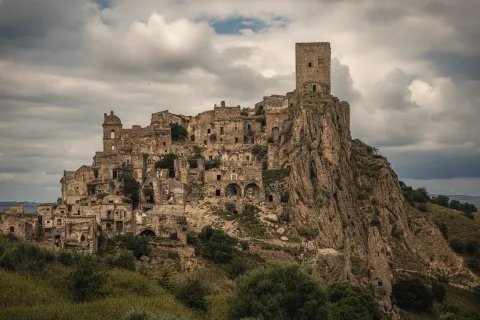
In the book that brought this story back to light in the twentieth century, Benedetto Croce traced the origins of the stronghold to a Roman castrum guarding the last narrows of the river Sinni: from that point on, the valley opens towards the Ionian Sea. What stands today above Valsinni was probably raised on an earlier Lombard fortification, in the first years after 1000, and looks Aragonese. Its fame, though, does not come from the walls: it comes from Isabella di Morra, born here around 1520 and killed here by her brothers at about 26, when they discovered her correspondence with Diego Sandoval de Castro, baron of Bollita.
What to see
The castle, together with the fief of Favale — the name Valsinni bore at the time — had come to the Morra family in the early sixteenth century through the noblewoman Menocca Vivacqua, and the family held it, through ups and downs, for some 140 years, until 1638; since 1921 it has belonged to the Rinaldi family. Inside, works, documents and writings recount the poet's story and her solitude. Her father, Giovan Michele Morra, had backed Francis I: after 1528 the fief passed to the Spanish Crown and he had to take refuge in France with his son Scipione, while Isabella stayed here with her mother Luisa Brancaccio and her other brothers. After the murder the brothers fled to France as well; Isabella's body was never found.
The building occupies the highest point of the old borgo and commands the Sinni valley. The alleys run round it in concentric, stacked rows, and among the houses you come across the gafi, roofed stone passages that cut under a dwelling to connect two streets at different levels.
Visiting
Cars do not enter the old borgo: you leave the car outside and climb on foot along the narrow lanes that work their way up the rocky spur. Visits to the castle are part of the programme of the Isabella Morra literary park, set up in 1993 around the castle and the village, which in summer fills the old centre with art and craft exhibitions, storytellers and readings of her verse.
Our editors' tip
Take a few of Isabella's poems with you and read them only once you are up there, looking down the valley to the point where the river leaves the gorge: that is the last narrows of the Sinni, the one Croce writes about. The steady sound of the water that once accompanied life in the village is much fainter now: since 1985 the Monte Cotugno dam has held back most of the river.