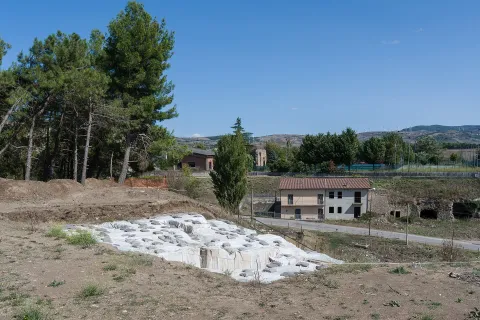
The parish museum of sacred art in Pescopagano exists because of one date: 23 November 1980. The works it holds come from the churches of the town, destroyed or badly damaged by the Irpinia earthquake, which killed around twenty people here. Recovered and partly restored, they span four centuries, from the sixteenth to the early twentieth. It is not a collection assembled by choice, then, but what was left standing of a heritage that lay scattered among the town's churches.
What to see
The core is made of wooden and marble sculptures, paintings and sacred vestments. The two pieces to look for first are both from the sixteenth century: a Cristo Crocifisso and a Madonna della Neve. Next to them sits a miscellaneous section gathering the memory of the Christian community of Pescopagano, the least showy part and perhaps the most useful for understanding the town.
To grasp where all this came from, look at what is left of the churches it came from. Of the monastery church of Santa Maria delle Grazie, whose convent was born in 1576, only the façade with its baroque portal still stands, and it is unsafe. In the church of the Incoronata the tremor brought down the side walls and with them the carved wooden choir. In the mother church of Santa Maria Assunta the choir made by Francesco Errico, finished in 1877, simply vanished after the earthquake.
Visiting
This is a parish museum, so opening depends on the parish: it is worth phoning ahead or asking at the presbytery before you drive up to the town. The rest is done on foot in the old centre, where the churches the works came from stand a few minutes apart. San Giovanni Battista, the oldest — an inscription on its pediment suggested a first foundation around 970 —, has been fully restored and is open for worship; San Leonardo, in the Basso la Terra quarter, opens only a few times a year, for the novena and the feast of the Immaculate Conception.
Our editors' tip
Before or after the museum, walk over to the monastery church of Santa Maria delle Grazie and stand in front of that baroque portal left on its own, with no church behind it any more. It explains the museum better than any caption: what you see indoors is what was carried out in time from buildings reduced to that.