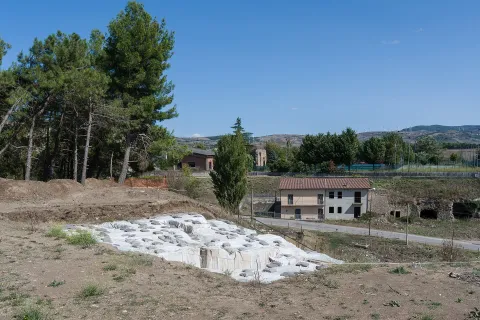
The first reliable news of who lived in the castle of Pescopagano takes us to 1164 and to count Gionata di Balvano. Little of that stronghold survives: rather than a castle proper it was a fortress, and of the fortress you can barely make out a ruined tower structure, buried under ivy and brambles. A heap of boulders, to put it plainly, but set at the exact point from which the whole valley of the Ofanto could be watched.
What to see
The crag is the real reason for everything. Here, after the battle of the Volturno in 554, the seven thousand Goths who later surrendered to Narses took refuge: Pescopagano, Montecalvo and Cairano, all within the circuit of Conza, were the high points where people went to be safe. In 867 the Saracens built a fortified post here, and in the Norman-Swabian period the place ended up in the county of Balvano, the same county as count Gionata.
The rest is a chain of handovers: in 1278 Charles I of Anjou granted the fief to Raynaldo de Panzellis Gallico, in 1331 it passed to Filippo Stendardo, then it was given to queen Sancha of Aragon, who sold it to Mattia Gesualdo; in 1697 the marquesses d'Andrea bought it and held it until the end of feudalism. Of the defensive system, besides the ruins on the summit, scattered pieces survive down in the old centre: on the eastern side of Palazzo Pascale, built over a pre-existing medieval complex, one of the towers of the old walls is still visible, while the Torre dell'Orologio rests on the ancient Porta Sibilla.
Visiting
The castle is reached by a path that was only recently put back in order. At the top there is nothing to visit in the usual sense, no rooms, no museum route, no ticket office, but there is the viewpoint, and the view runs for more than 25 km down the valley below. Count on ivy and brambles: what you find is a ruin, not an equipped monument.
Our editors' tip
Do not climb up expecting a castle: what you get is a heap of boulders under ivy. Go for the opposite reason, to understand why here of all places, and stand facing the valley: it is those 25 km of the Ofanto that explain 554, 867 and 1164 all at once. Then go back down into the village and look, on the east side of Palazzo Pascale, for the tower of the old walls: down there the defensive system reads better than it does on the summit.