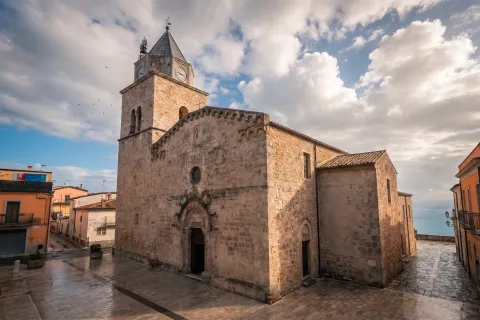
The mother church of San Fele is built from the wreckage of what stood above it. When it went up in 1514, at the foot of Monte Castello, the builders used material fallen from the fortress and the town walls: dressed blocks that earthquakes had tipped down the slope and that nobody in a village of stone would have dreamed of leaving there. Santa Maria della Quercia therefore stands in the highest part of the town, leaning against the mountain that supplied its walls. The main body, three naves on a Greek-cross plan, is 16th-century; the dome came two centuries later, in the 18th.
What to see
Inside, the oldest piece is a life-size wooden crucifix. Not far from it, a 17th-century canvas by an unknown painter shows Saint Rose of Viterbo: it was not made for this church but came from the monastery of Sant'Antonio, a building long gone, on whose remains the town cemetery was built. In this village even the paintings move when the buildings fall.
In the left aisle stands an urn with the relics of Saint Justin de Jacobis, the missionary born in San Fele on 9 October 1800, whose birthplace is a short walk away in the old centre. The saint is also the subject of the open-air statue on the main staircase, raised to commemorate his canonisation in 1975.
Visiting
The church was shut for a long time: the earthquake of 1980 opened vertical cracks in the façade, the arches and the vaults, with plaster and stucco coming away and partly collapsing, and it reopened to the public only in the early 2000s. You go in from the main staircase, the one with the statue of Saint Justin. The first thing to look at is the plan: stop on the threshold, because a Greek cross is unusual for a village mother church and from there you take it in all at once.
Our editors' tip
Study the masonry from outside before going in, then walk down towards Palazzo Frascella: there too the blocks come from the fortress of Otto I of Saxony, and the Norman-style tower absorbed into the palazzo is all that stayed standing of the old church of San Sebastiano after the earthquake of 1456. In a town classed in seismic zone 1, stones change buildings more often than they change shape.