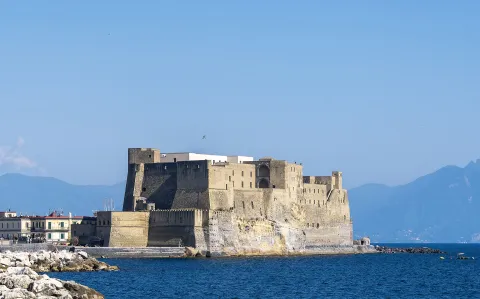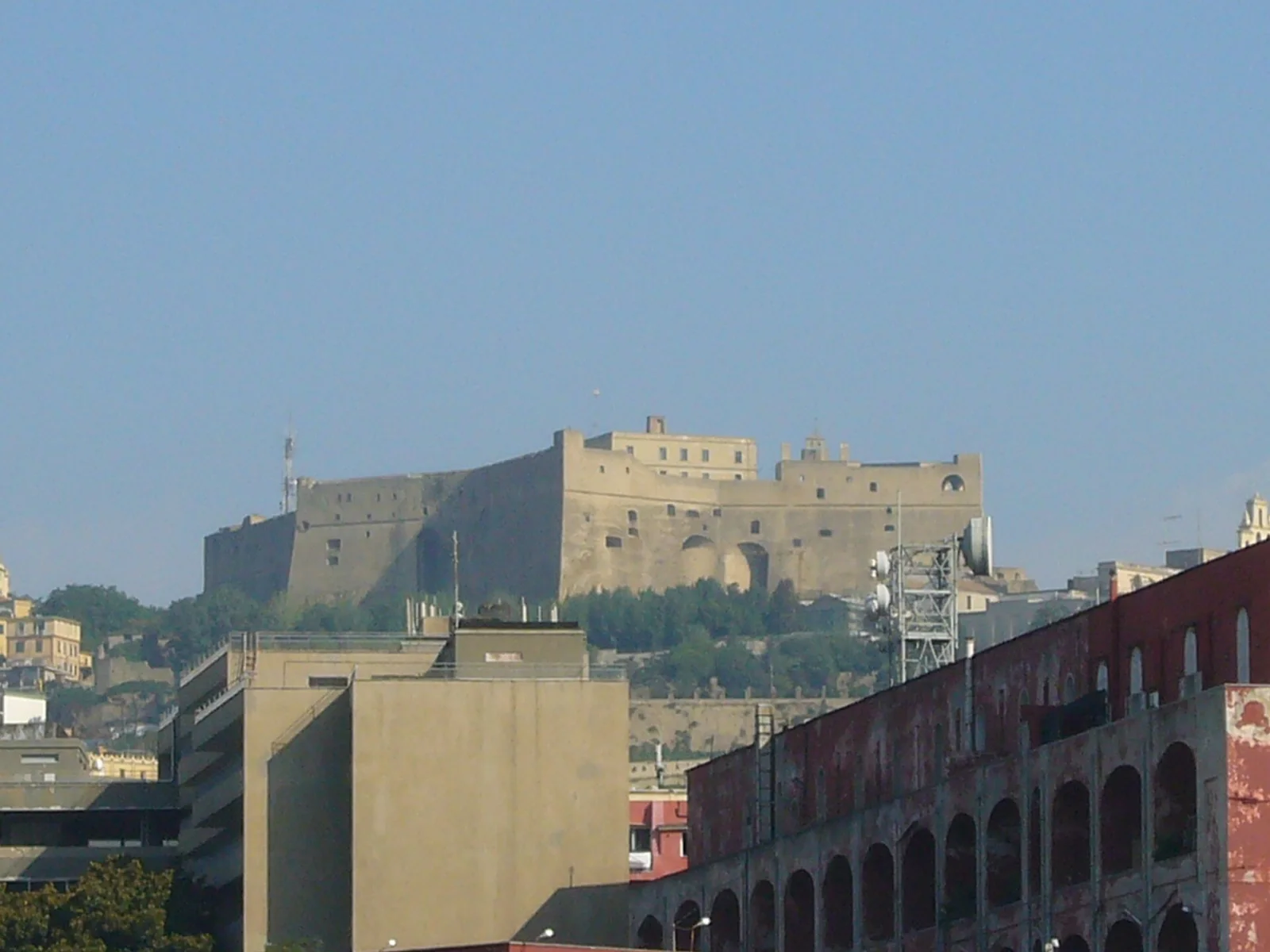
It is the star of tufa that closes every postcard of Naples, the fortress on the Vomero hill that has looked down on the city for seven centuries and almost always from the wrong side: Robert of Anjou had a fortified palace built here in 1329 by Tino di Camaino, and the Spanish viceroys remade it from 1537 for Charles V as a six-pointed war machine, without towers, with the gun emplacements in the re-entrant angles, which the Valencian architect Pedro Luis Escrivà had to defend from criticism with a written apologia. It never served to repel an enemy: it served to bombard the Neapolitans in 1647 and in 1799, and to keep in prison those who caused trouble.
What to see
The climb is already the castle: the ramp, the bridge with the loopholes, the piperno portal with the two-headed eagle of Charles V, the Hermit's Grotto, the guillotine gate of the Napoleonic age and the cells. Here Tommaso Campanella spent four years, here the Jacobins of the Republic of 1799 ended up, Mario Pagano, Gennaro Serra, Luisa Sanfelice, and half a century later the patriots of the Risorgimento, Poerio, Spaventa; it was a military prison until 1952, then the Navy, then twelve years of restoration and the opening to the public in 1988.
At the top, the parade ground: a lawn of stone two hundred and fifty metres above the sea, with the complete circuit of the bastions and the view no other point in Naples has, Vesuvius, the gulf as far as Capri, Posillipo, the Phlegraean Fields, and beneath your feet the old centre with the decumanus cutting straight through. On the square the little church of Sant'Erasmo, rebuilt by Domenico Fontana after lightning blew up the powder magazine in 1587 killing a hundred and fifty men, and in the halls the Napoli Novecento museum, with the painters and sculptors of the city from Futurism to the eighties.
Visiting
You go up to the Vomero by the Centrale or Montesanto funiculars, then five minutes on foot along Via Tito Angelini; its own ticket, inexpensive, open every day except one a week, to be checked. Next door, the Certosa di San Martino with the museum and the nativity scenes: half a day for both. The descent on foot by the Pedamentina, the steps that go down to Spaccanapoli, is the best part.
Our editors' tip
Climb onto the bastions an hour before sunset and do the full circuit anticlockwise, starting from Vesuvius: the light changes colour over the city and at a certain point the lights of the port come on. Then look, on the northern parapet, for the long railing with the inscription in Braille, the work that tells the blind what lies below: it is the most Neapolitan way of explaining a view.