In the seventeenth century Carlo Celano measured it in paces: 1128 from one end to the other. Neapolitans call it Spaccanapoli, the Naples-splitter, because it cuts the old city in two along a line that never bends; on the map it is the lower decumanus of Roman Neapolis, and before that one of the three Greek plateiai of a grid laid out at the end of the 6th century BC — local tradition prefers 470 BC. It is not an official name: the street changes its plaque six or seven times along the way. The historic centre it crosses is the largest in Italy at 17 km², and since 1995 a section of 10.21 km² has been on the UNESCO World Heritage list.
What to see
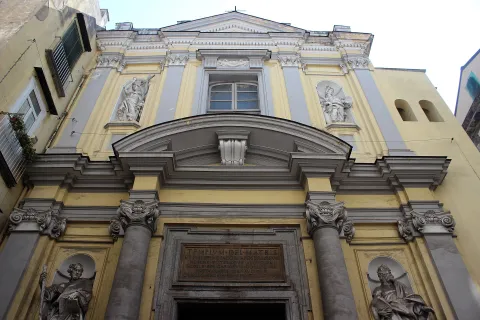
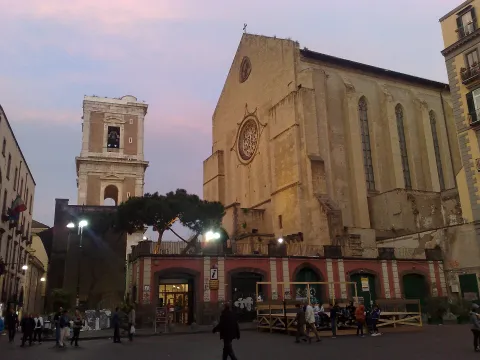
From the west you start at piazza del Gesù Nuovo, with the obelisk of the Immacolata and the diamond-point façade of the Gesù Nuovo church. A few metres on, the Santa Chiara complex opens up, founded in the fourteenth century by Robert of Anjou. Via Benedetto Croce leads to piazza San Domenico Maggiore, with its obelisk and the basilica where Thomas Aquinas studied and taught; at piazzetta Nilo stands the statue of the river god Nile, the “Body of Naples” that gives the square its name. The street then becomes via San Biagio dei Librai and, past via Duomo, continues as via Vicaria Vecchia, via Forcella, via Giudecca Vecchia and via Ottavio Tupputi.
The Greek plan is still readable with the naked eye: the blocks measure roughly 180 metres by 35, a ratio of one to five, and the cross-alleys that separate them are barely three metres wide. The old centre alone holds more than 200 historic churches, with work by Caravaggio, Luca Giordano, Jusepe de Ribera, Cosimo Fanzago and Giuseppe Sanmartino.
Visiting
On foot is the only way: cars cannot get through, scooters can, so you walk close to the walls. Metro line 1 stops at Dante and Università, line 2 at Montesanto and Cavour; from any of the four you are on the route within ten minutes. Walking the whole length without going into anything takes a little over half an hour; add Santa Chiara, San Domenico and the Sansevero chapel next door and the day is gone. Churches close at lunchtime and the Sansevero chapel has to be booked. The paving is smooth basalt slabs, so wear shoes with a decent sole.
Our editors' tip
Before you walk it, go and look at it. From the belvedere of the Certosa di San Martino, up on the Vomero, the cut is unmistakable: a straight furrow through the roofs, with the rest of the city grown crooked around it. Then come down and do it backwards, from via Duomo towards the Gesù: the eastern stretch, the Forcella end, is the least walked and the most honest.