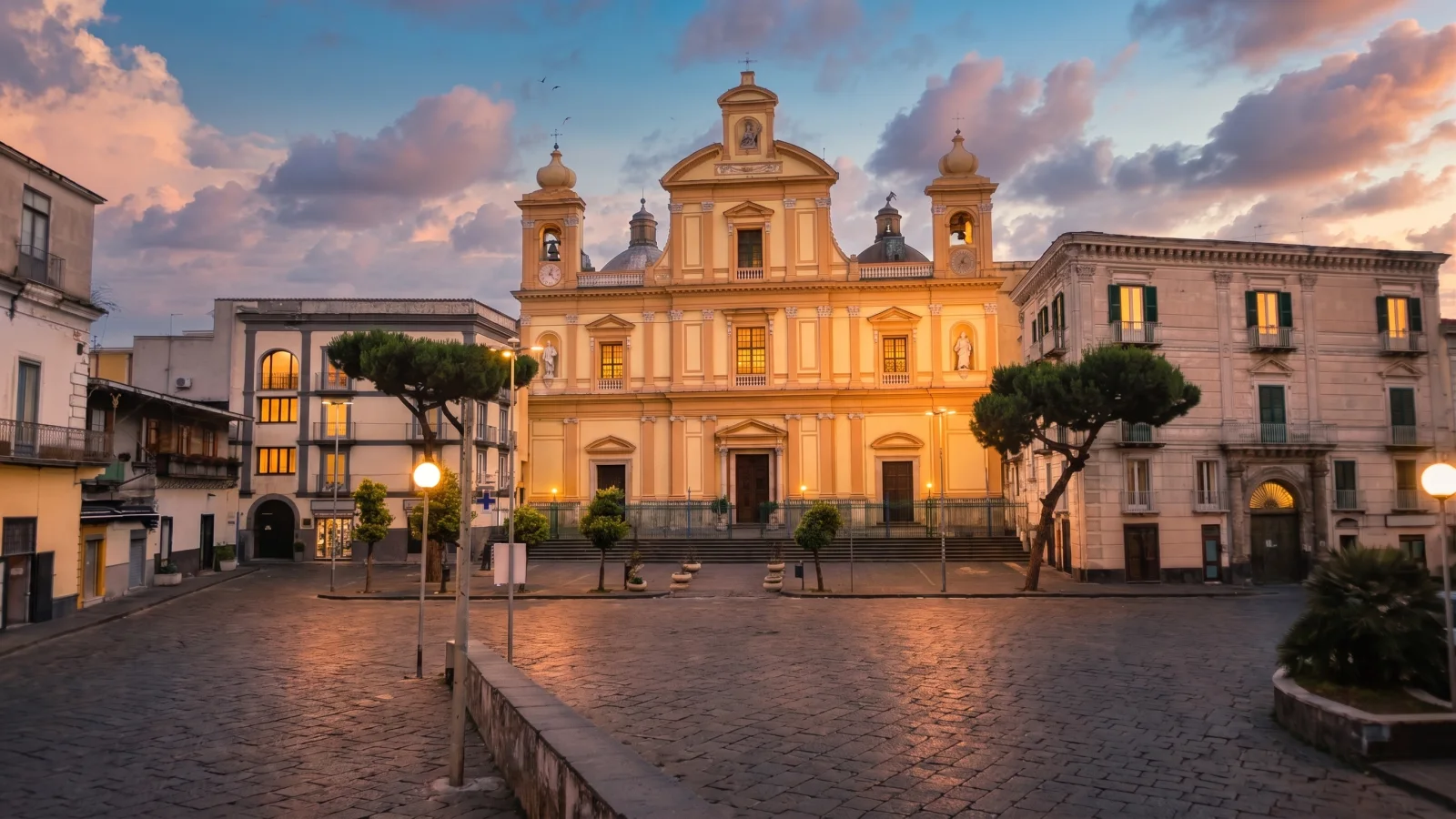
Chiesa dello Spirito Santo
The church of a sixteenth-century confraternity in Sant'Antimo: seventeenth-century piperno façade and a dome.
2 places covered in Sant'Antimo
No place with that name: try fewer letters.
The church of a sixteenth-century confraternity in Sant'Antimo: seventeenth-century piperno façade and a dome.
The patron's sanctuary on the square in Sant'Antimo: eighteenth-century church, the martyr's relics, a silver statue.
The baronial castle of Sant'Antimo is a sixteenth-century building and, with the patron's sanctuary, one of the landmarks of the town. The fief passed from the Filangieri to the Stendardo, who held it until 1566, when it was sold to the Revertera. Duke Francesco Revertera was regarded as a benefactor: he obtained that the town be declared «Camera Riservata del Duca», freeing the citizens from heavy burdens such as that of lodging troops passing through. In 1629 castle and fief were sold to Francesco Ruffo, Duke of Bagnara, and in 1641 Sant'Antimo was raised to a principality. In 1756 came the Mirelli, princes of Teora, who renovated the palace and remade the façade, with friezes around windows and balconies.
The castle is square in shape and is reached by a short ramp. The façade has a large portal of lava stone and the arched windows of the keep; the keep and the two side towers are crowned by swallow-tail merlons. Inside, an entrance hall covered by a barrel vault leads to the open courtyard, a palm grove around a decorative well.
On the north side is a large cellar, called «il grottone», which was the great stable for the horses of the men-at-arms; on the south the small stable for the horses of the baronial carriage, the carriage room and a private chapel. On the first floor runs a loggia with piers and arches of piperno, covered by wooden beams, from which you enter the main floor: a row of rooms with gilded eighteenth-century doors and, in one hall, a Rococo fresco of a peasant's homage to his master.
The castle is private property: since the eighties of the nineteenth century it has belonged to the Giannangeli family. Since 1912 it has been a national monument. Whether and how the interior can be seen should be checked beforehand; from Piazza della Repubblica you can see its façade.
The square itself was part of the castle: it was the small garden in front of the building, expropriated by the town council in 1896. And during some excavations two underground rooms were found, reached through a trapdoor in the floor. In one there were rings on the walls and bones: a torture chamber was imagined, but it was the castle's old prison.
Skip the line and see the best with a guide: hand-picked tickets and tours.
Some links may earn BigItalia a commission, at no extra cost to you.
Pizza Napoletana · Caprese
Compare hotels, B&Bs and holiday homes on Booking.com for your dates.
Next up: Saint Antimus, patron whose feast preserves the rare «Flight of the Angels», Tuesday 11 May
Nearest airport: Napoli Capodichino, 8 km away
The closest destinations covered by our editors, with straight-line distance.


