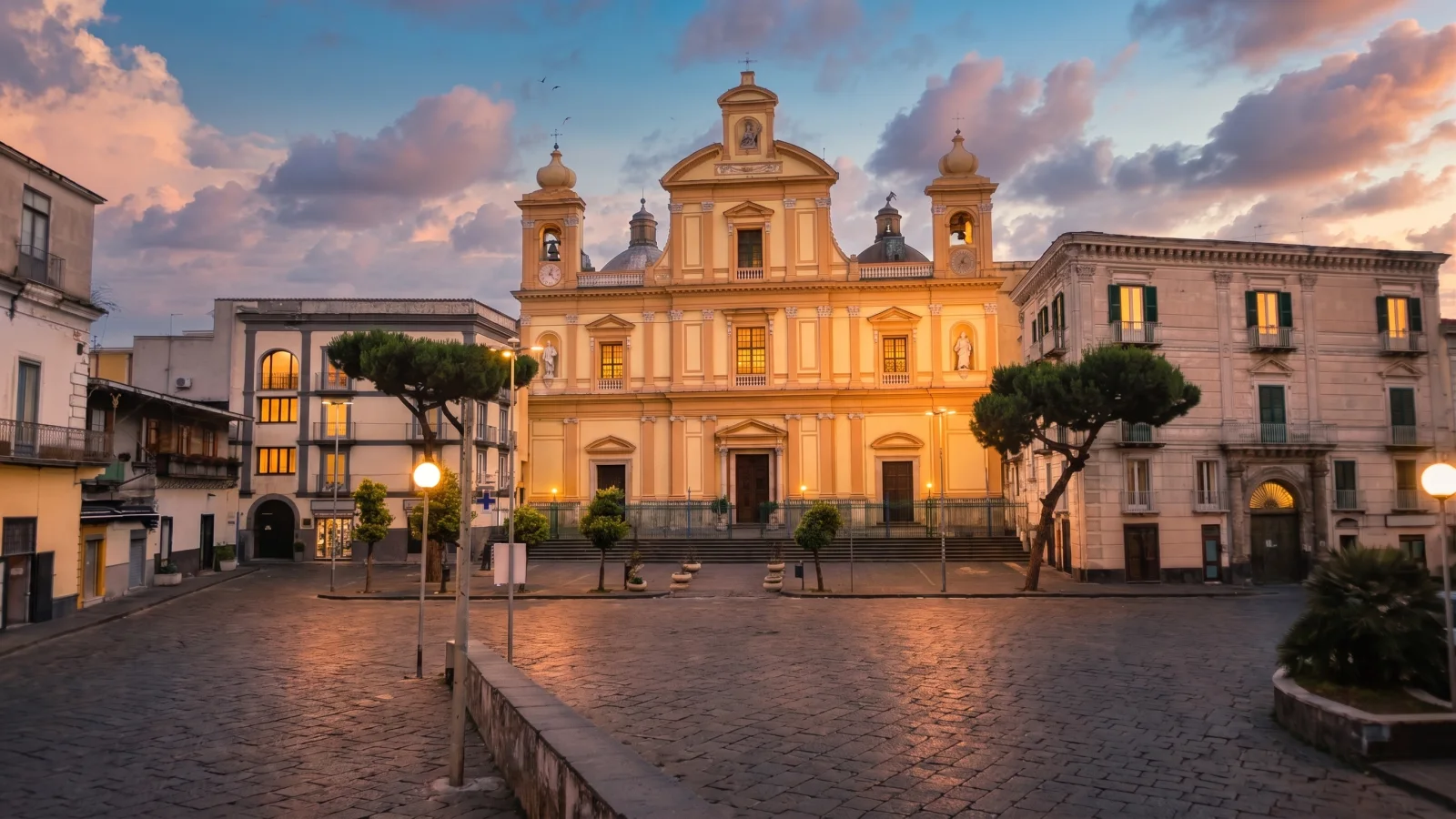
Sant'Antimo bears the name of a priest martyred at the beginning of the fourth century, and the town grew up around his sanctuary: it was the shrine that drew the roads here, and with the roads the pilgrims and the merchants. But there was another reason to stand on this spot. In the Friano district, near the Ponte Mezzotta, stood a fortified settlement along the border between the Duchy of Naples and the Principality of Capua, on a route that followed the old via Antiqua. The castle is attested before 1151 by a parchment and still appears in the Angevin registers; today it is gone, and no one even knows exactly where it stood. Of the hamlet that grew around it there remains the ruin of a church. That border, for that matter, has left its mark all over the area: Melito, next door, carries in its name the ditch that marked it, and Mugnano the fact of having been a fortified place on the duchy's edge.
The town's convent has had more lives than usually fall to a building: from 1869 it housed the civic hospital, the nursery, the orphanage and the elementary schools, while the friars were left a few rooms for worship; then the bishop of Aversa bought it, the Salesians passed through, then the friars of San Pietro ad Aram; in the nineties it was a rehabilitation community for drug addicts, and in the end the Franciscans came back. The centre stayed as it had always been until the war: the only changes had been, at the end of the nineteenth century, the three axes of via Principe di Napoli, via Marconi and via Roma, and the laying out of the square. From 1882 and for almost eighty years, what kept the town attached to Naples and Aversa was a branch of the tramway. Today it is the railway and the main road that do it, and Naples, the airport and the Domitian coast are minutes away.