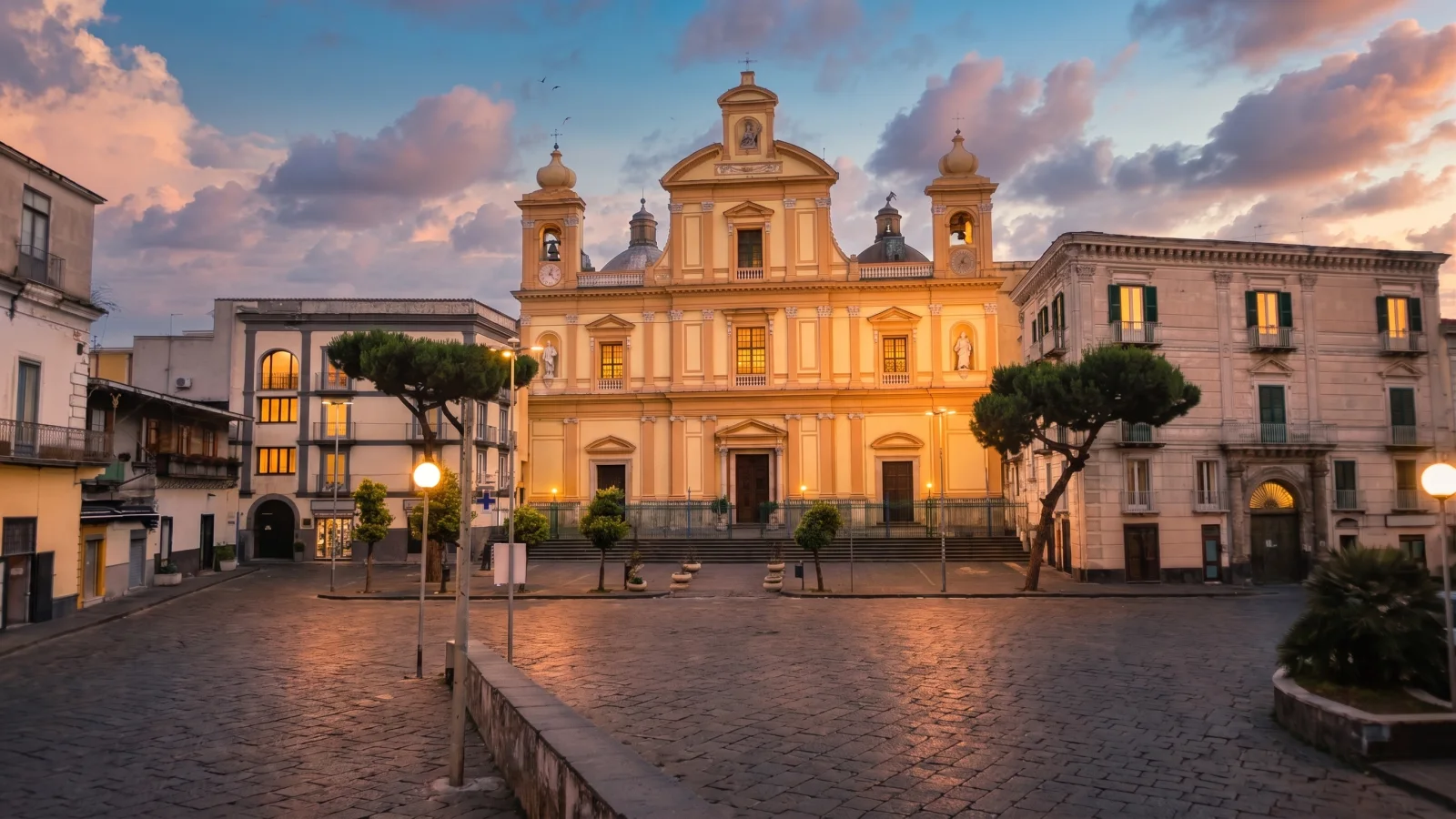
The church of the Spirito Santo, in Sant'Antimo, comes from the confraternity of the same name, founded in 1559 in the church of the Annunziata. The first years were difficult because of the clashes with the rector of the parish, until the brethren appealed to the pope: by a measure of 1 October 1578 Gregory XIII recognised the confraternity and its full autonomy in managing its assets. The brotherhood combined religious practices with commitment to the poor and the sick. Later the patronage of the church passed to the università, that is, the municipality, which every year elected its administrators. The original oratory corresponds to today's presbytery and sacristy.
What to see
The church faces the square that bears its name, where Via Libertà, Via Lava and Via S. Russo meet. The façade dates from the seventeenth century, in two superimposed orders on a base of piperno. Also of piperno is the portal, between two Ionic half-pilasters, with a broken tympanum at whose centre an aedicule opens: recent restorations have brought back to light there a fresco of Pentecost. In the cartouche above the aedicule is carved the date 1723, that of the stucco works. At the top of the façade a stucco group shows the symbol of the church: a dove carried by three seraphs, from which rays of light spread out.
The interior is a Latin cross, with a nave and two aisles, side chapels and a wide transept. It owes its present appearance to the works of the early eighteenth century, made necessary by the earthquakes: they were designed by the architect Antonino Notarnicola and carried out from 1720 by Vincenzo Pomaro. At the crossing with the transept rises the circular dome, on a high drum, with the four Evangelists in the pendentives. Below stands the high altar, of fine marbles with inlays of lapis lazuli and decorations of gilded copper.
Visiting
After the earthquake of 1980 the church remained unfit for use until 2009; it has since been consolidated and restored. Opening times and the times of services should be checked on the spot.
Our editors' tip
The high altar you see is largely a recovery: on 4 December 1989 a theft and acts of vandalism reduced it almost to its bare masonry skeleton. Most of the original elements were found again, and the restoration has given it back almost entirely its earlier appearance; the balustrade of the presbytery has also been partly rebuilt.


