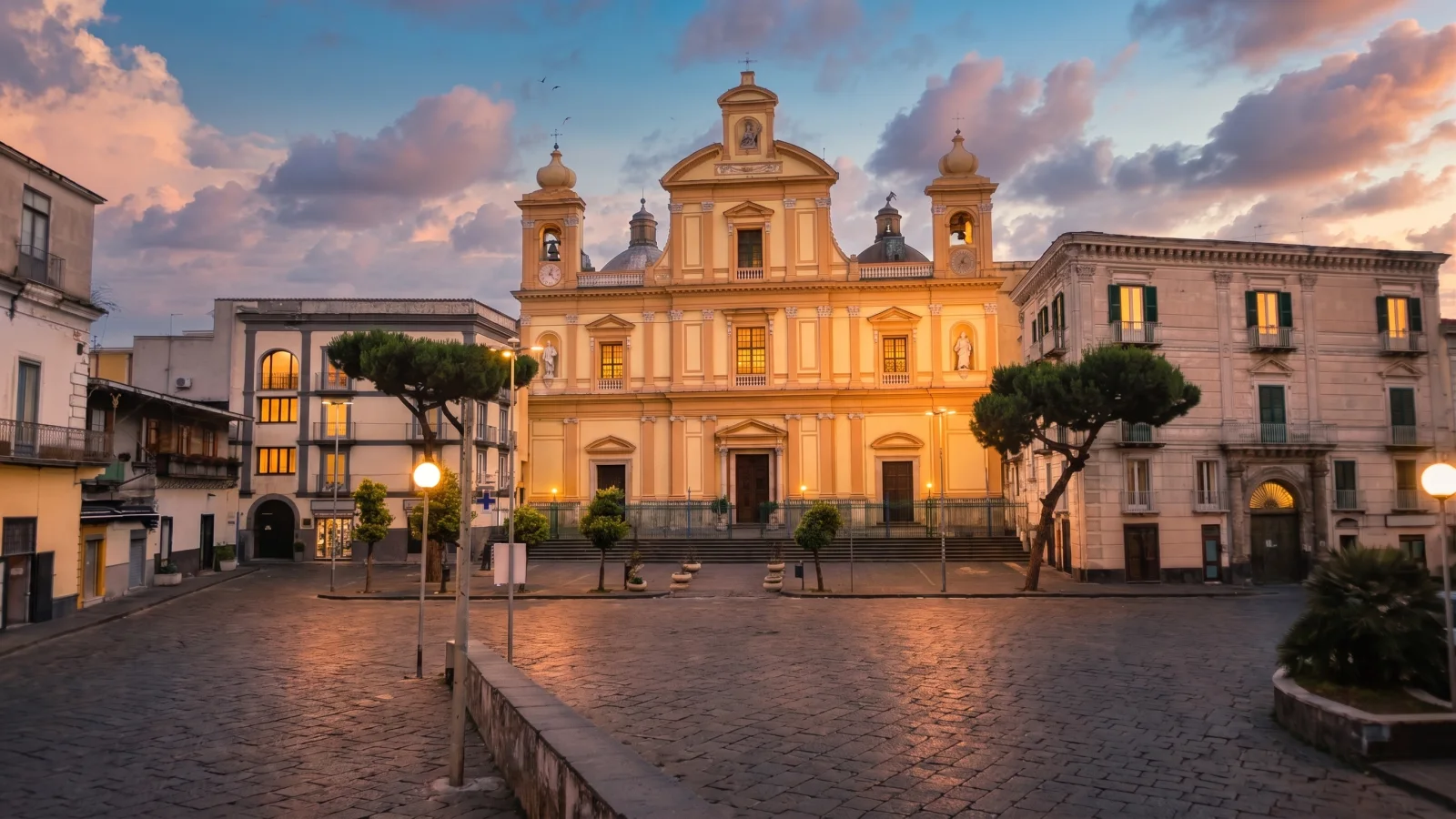
The sanctuary of Sant'Antimo Prete e Martire faces Piazza della Repubblica, the main square of Sant'Antimo, in the diocese of Aversa. According to a well-established tradition the first nucleus goes back to the year 816: the Byzantine duke Antimo of Naples, having stopped to rest during a hunt, is said to have seen in a dream the martyr, who asked him for a chapel in his honour. The oratory was later enlarged and became a parish. At the beginning of the eighteenth century the church was rebuilt from the foundations: the design by the engineer Antonio Guidetti, approved in 1719, turned it by ninety degrees with respect to the old Latin-cross plan, and the works ended in 1724.
What to see
The façade dates from the twenties of the twentieth century, finished in 1924: to the earlier one, in two orders, a third was added, inspired by the church of the Girolamini in Naples, which culminates in a broken tympanum with the stone statue of the patron; in the niches of the second order are Saints Peter and Paul. Inside, the nave has a coffered ceiling of 1725, with at its centre the Martyrdom of St Antimo, a canvas by Nicola Malinconico. In the presbytery, above the altar of polychrome marbles, is the Glory of St Antimo by Paolo De Majo. Over the side aisles rise four domes, two on each side.
The patron's chapel is the third in the right aisle, closed by two iron gates of 1866. It was built at the expense of the università, that is, the municipality, to receive the relics of the martyr, donated to the town on 11 August 1658: today they are in a silver urn under the table of the altar, which is of inlaid marble. In the niche on the left is the silver statue of the saint, made in 1712 by the silversmiths Alessandro and Gennaro Cioffi on a model by Domenico Antonio Vaccaro.
Visiting
Opening and Mass times should be checked with the parish. The earthquake of 23 July 1930 seriously damaged the building, which was then consolidated and restored.
Our editors' tip
On the gallery there is an eighteenth-century organ, built by Biagio and Nicola Di Rosa, father and son, of Cardito. Look at the coat of arms on top: it shows the monstrance with St Antimo on one side and the Madonna on the other, recalling the confraternities and chapels that paid for the instrument.


