
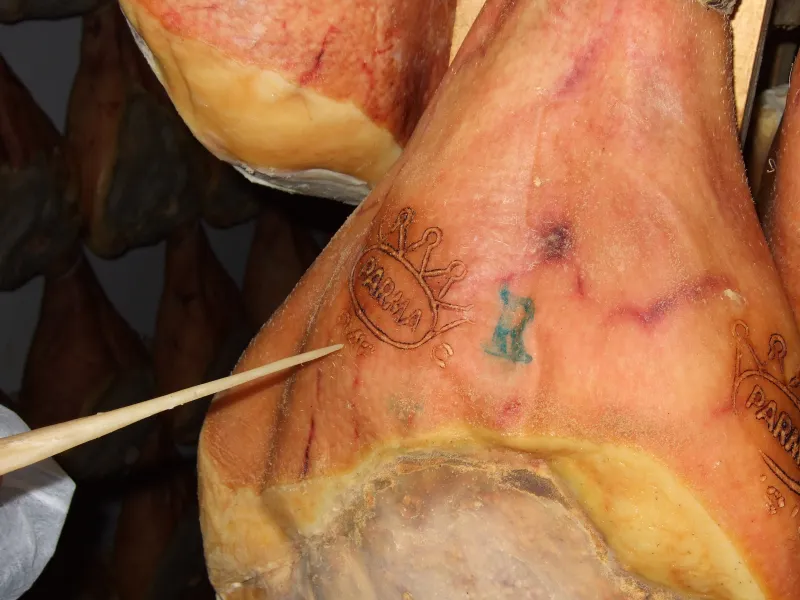
Prosciutto di Parma pork leg and sea salt, aged at least twelve months
Only Italian pork and sea salt, aged for at least twelve months: Prosciutto di Parma has held Protected Designation of Origin status since 1996.
Read more →The name comes from a Roman owner: Solinius, or Solenius, with the suffix -anus that marked possession of an estate; in the documents it appears as Solegnano in the thirteenth century. The castle was built around the year one thousand, sheer above the Taro valley, at the will of the chapter of Parma cathedral, which in 1039 granted it in emphyteusis to Boniface of Canossa, Matilda's father. It later passed to the Pallavicino in 1249, and in 1405 the troops of Ottobuono de' Terzi attacked it without managing to take it.
The churches here can be read as layers. San Lorenzo is mentioned as early as 1039, when it stood inside the castle walls: destroyed in 1405, it was rebuilt outside the perimeter and then remade several times, until it turned neoclassical. Santa Felicita, at Prelerna, is Romanesque and has taken into its stone wall blocks carved with medieval high reliefs. And the oratory that the Benedictines of the monastery of Carpadasco raised in 1219 was pulled down in 1269, when the militias of Piacenza stormed the castle.
Only Italian pork and sea salt, aged for at least twelve months: Prosciutto di Parma has held Protected Designation of Origin status since 1996.
Read more →Straight-line distances from the town centre. Tap a point to open its page.
The closest destinations covered by our editors, with straight-line distance.


