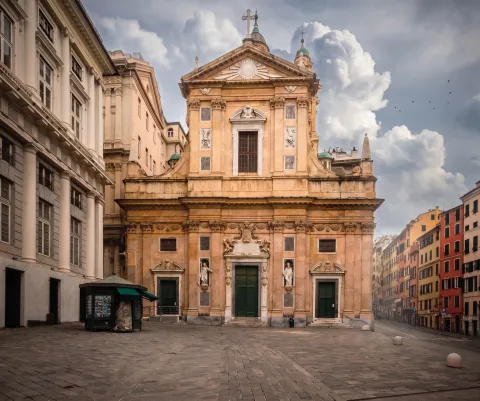
On 9 February 1941, during Operation Grog, a shell fired by a British warship tore a hole in the roof of the Carlo Felice and destroyed the ceiling of the auditorium, a wide ring of angels and cherubs in brightly painted high relief that had no equal in Genoa. It was only the start: incendiary bombs on 5 August 1943 burned the scenery behind the stage, looters carried off every scrap of metal and a raid in September 1944 brought down the front. Of the theatre opened in 1828, the walls and the pronaos were what remained.
What to see
The original design was by Carlo Barabino, who won the competition in 1825 ahead of Luigi Canonica from Ticino, brought in later anyway to advise on the stage. The theatre rose where the church and convent of San Domenico had stood, cut down to warehouses and barracks from 1797, and opened on 7 April 1828 in the presence of Carlo Felice of Savoy and Queen Maria Cristina with Vincenzo Bellini's Bianca e Fernando, rewritten for the occasion to a libretto by the Genoese Felice Romani. The hall held about 2,500 people in five tiers of thirty-three boxes each.
What stands today is the theatre of Aldo Rossi, Ignazio Gardella and Fabio Reinhart, who won the competition that closed in 1984 after the designs of Paolo Antonio Chessa and Carlo Scarpa had stayed on paper. The brief required keeping the Doric pronaos and the portico with its original reliefs; behind them the stage tower doubles the nineteenth-century volume and holds four stages, two of them movable and set lower down. In the foyer, on either side of the cone that is the building's signature, Aurelio Caminati painted two frescoes of 36 square metres: one shows the Genoese trading post on the island of Tabarka, the other Guglielmo Embriaco setting off for the first crusade in 1102.
Visiting
The theatre faces piazza De Ferrari, beside the equestrian monument to Garibaldi, with a metro entrance right outside the door. The opera, symphonic and ballet seasons run from autumn to spring, and since 1991 the hall has also hosted the concerts of the Giovine Orchestra Genovese, which has been putting on chamber music in Genoa since 1912. The covered passage behind the pronaos, conceived as a continuation of the street between piazza De Ferrari and Galleria Mazzini, is the part of the design you notice first from outside.
Our editors' tip
We arrive half an hour early and spend it in the foyer, all 660 square metres of it: the Caminati frescoes only read from a distance and with time to spare. If you can choose your date, look for a performance in the small hall of 200 seats, with its own stage and a completely different feel from the large one. And walk round the portico before going in: the reliefs are Barabino's, the only original pieces that came through the bombs.