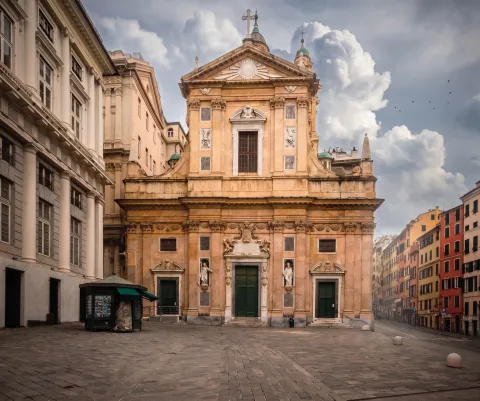
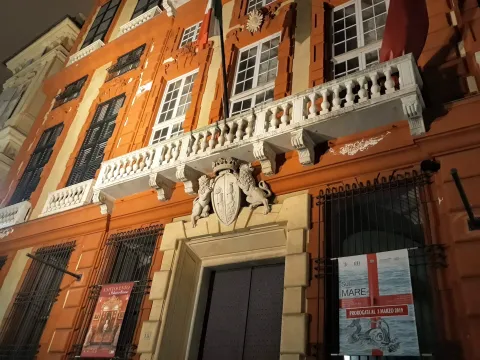
On 3 November 1777 a fire gutted the central block of the Doge's Palace and left standing only the ground-floor atrium and the great staircase. The marble front that now faces Piazza De Ferrari came out of that disaster: it was designed by the Ticinese architect Simone Cantoni and built between 1778 and 1783, one of the first pieces of neoclassicism in Genoa. The palace, still called Paxo by the locals, was the seat of the doge of the Republic; work on it had begun at the end of the thirteenth century, after victories over Pisa at Meloria in 1284 and over Venice at Curzola in 1298 had turned Genoa into a Mediterranean power.
What to see
Until 1291 the captains of the people had no premises of their own: that year Corrado Doria and Oberto Spinola bought the Doria houses, and three years later the palace of Alberto Fieschi was added, with the tower later known as the Grimaldina, six storeys high. The building took the name ducale in 1339, with the election of the first doge, Simone Boccanegra. What we see today, however, is the work of Andrea Ceresola, called il Vannone, commissioned by the senate in 1591 to make it a residence and a fortress at once: his are the great vaulted courtyard, the two arcaded courts and the staircase up to the piano nobile.
On the piano nobile are the halls of the Great and Minor Councils, where four hundred senators once sat and where the major exhibitions are held today. The decoration was put out to competition in 1700 at the expense of the Giustiniani marquises: over the Genoese painters, among them Domenico Piola and Lorenzo De Ferrari, the patrons chose the Bolognese Marcantonio Franceschini and the Neapolitan Francesco Solimena. On via Tommaso Reggio, Orlando Grosso's restoration brought back to light the abbots' loggia, the one medieval fragment Vannone had hidden behind a flat facade; in 1942 Allied bombs struck the joint between the central block and the west wing.
Visiting
The palace has two entrances, one on Piazza Matteotti and one on Piazza De Ferrari, a short walk from the cathedral of San Lorenzo. The courtyards and arcades are open to walk through and hold cafes, bookshops and cultural associations; you pay for the exhibitions on the piano nobile and for the climb up the Grimaldina tower. From 1815, with annexation to the Kingdom of Sardinia, the building stopped being the seat of government and became a courthouse, a role it kept until 1975: the 1992 restoration, for the five hundredth anniversary of the crossing to America, gave it back to the city as a place of culture.
Our editors' tip
Climb the Grimaldina even when no exhibition is running: from the top you read the maze of caruggi on one side and the port on the other, and the tower explains better than any hall why the senate wanted a palace that was also a fortress. Then stop in the main courtyard, which in July 2001 hosted the heads of state and government gathered in Genoa for the G8 summit: going in costs nothing, and it is the best place to grasp how far this building is still part of the city's life.