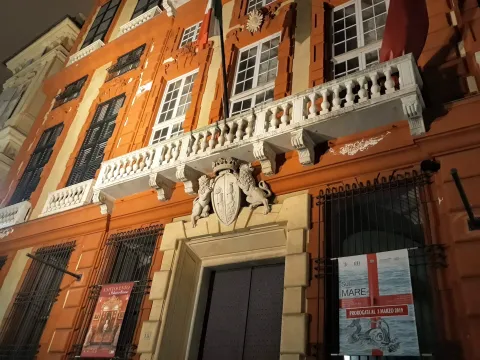
At number 4 of via Garibaldi stands the palace that Tobia Pallavicino — a wealthy alum merchant from one of the city's oldest noble families — had built between 1558 and 1561. It is the first known Genoese work by Giovan Battista Castello, called il Bergamasco, who worked here with Bartolomeo Riccio, Domenico Solari and Antonio Roderio. On 13 July 2006 it entered the UNESCO World Heritage list as one of the 42 Rolli palaces. The Chamber of Commerce has its offices inside.
What to see
Bergamasco came out of decoration and fresco painting, and here architecture and ornament advance together: ashlar in Finale stone on the ground floor, Ionic pilasters on the first, a façade of Renaissance clarity that owes much to Alessi. The two vestibules, on the ground floor and on the piano nobile, have reached us intact. Downstairs, white stucco frames run between minute grotesques and frescoes of the Olympian gods, with Juno and Leda in the central octagons; upstairs, in the brighter vestibule, the colours sharpen around Apollo Citharoedus with the Muses.
The second layer is eighteenth-century. Once the Carrega family owned it, the building gained a storey and was widened with two perpendicular wings towards piazza del Ferro. From that season come the chapel and the Galleria Dorata, the last works of Lorenzo De Ferrari, finished shortly before his death in 1744. In the chapel a trompe-l'œil colonnade in gilded stucco and fresco acts as a stage set for the Madonna Carrega carved by Pierre Puget around 1680: the original is in the Museo di Sant'Agostino, and since 2004 a copy stands here. The Galleria Dorata, designed between 1734 and 1744, holds gilded stucco, mirrors and frescoes in a single cycle drawn from the Aeneid, from the Council of the Gods on the vault to the flight from Troy, Aeneas and Dido, and the defeat of Turnus in the four roundels.
Visiting
This is not a museum with a ticket desk: the palace houses the Chamber of Commerce, and the state rooms are seen during the special openings of the Rolli circuit or by arrangement. Via Garibaldi, the Strada Nuova laid out a few years earlier by Cantoni, takes ten minutes to walk end to end and lines up the other palaces of the system, so it makes sense to take this one inside a wider round rather than on its own.
Our editors' tip
In the Galleria Dorata stand in a corner, not in the middle. The mirrors throw back the frescoes of the vault, and the play between canvas, gilded stucco and reflection — the thing De Ferrari was after — only reads from an angle. Afterwards go to the Museo di Sant'Agostino to see Puget's Madonna: what you have in front of you here is a copy.