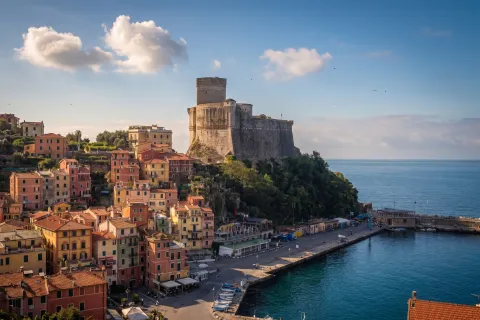
The castle at San Terenzo was not the work of a lord or a republic: in 1360 the people of the fishing village built it themselves, on their own initiative, with no artillery and no garrison. A document of 29 July 1588 in the state archive of Genoa confirms its origin, and at the end of the sixteenth century the podestà Gregorio Cadamartori, reporting to doge Davide Vaccari on his inspection of the fortifications around the Gulf of La Spezia, dismissed it as a “little castle built in years past by the people of that village”. That little castle is still there, on a rock spur at the western end of the bay.
What to see
The plan is an irregular pentagon, with three round turrets on the corners facing the village, heavy curtain walls enclosing a second inner circuit, and a square-based keep with Guelph merlons and square corbels. It did not start out that way: at first there was only a battlemented square tower some ten metres high, meant for spotting sails on the horizon. Everything else came later, when the watchtower had to become a bastion against raids by Ottoman corsairs.
On the landward side a broad barbican and a moat protected the wall; the moat has been filled in, and only a loophole in the northern bulwark still marks where it ran. Below the headland opens a cave that people here still call the Tana dei Turchi, the Turks' den, and the name says plainly where the fear came from. Among the first castellans the records name Giovanni da Mongiardino, already castellan of Lerici in 1401, commanding eight crossbowmen, and Giacomo Rossi from San Terenzo, who fought the Pisans and earned the praise of Simone Boccanegra: the castle then belonged to the Genoese defensive system in the gulf, and later worked in tandem with the far larger fortress of Lerici.
Visiting
You climb from piazza Brusacà, take via Meneghetti and then the ramp to the entrance: a few minutes on foot from the beach, all of it uphill. Since December 2014 the castle has been run by the Ministry of Culture through the Polo museale della Liguria, which became the Direzione regionale Musei in December 2019; opening hours follow the state museum calendar, so check them before you set out. Do not expect furnished rooms inside: what counts is the military structure and the view it commands.
Our editors' tip
Go in the late afternoon, when the light comes in low from the west and the bay empties out. From the wall walks you can read why the fort stands exactly here: that tooth of rock controls the whole stretch of water in front of the village and half the Gulf of Poets. Then walk down towards Casa Magni, the house on the shore where Shelley spent his last months: five minutes away, and the contrast between war stone and poets' beach is worth the detour.