On 13 June 1822 Lord Byron's schooner Bolivar sailed into the cove at San Terenzo and fired six cannon shots to announce itself: waiting ashore, in a white house whose door opened straight onto the sand, were Percy Bysshe Shelley and his household. The building had gone up in the sixteenth century as a monastery of the Barnabite fathers, then passed into private hands and was cut down to a summer residence. A map of 1729 assigns it to the De Rocca family and already shows it as it looks today: five windows on the seaward front and the arcaded portico built on the rocks. The present name comes from the Magni, who took over later.
What to see
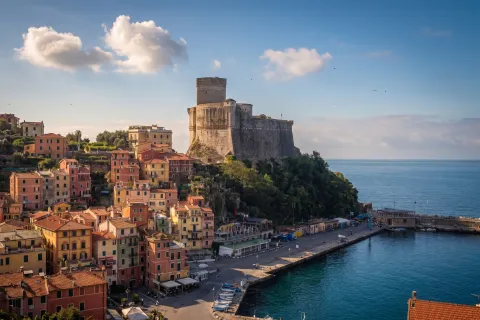
The house stands east of the old village of San Terenzo, where the ground begins to climb towards the point of Marigola. From the beach you can read the two things that held Shelley here: the row of windows facing the water and the arched portico resting directly on the rock, with the sea working underneath. Behind it rises the promontory, wooded with walnut and holm oak. Villa Marigola, which today looks like part of the same estate, was only built at the end of the eighteenth century by the Ollandini, who later held Villa Magni as well.
The Shelleys settled here in the April of that year with their son Percy Florence, Claire Clairmont, Edward and Jane Williams, John Trelawny and a constant traffic of guests. They slept on straw mattresses borrowed from the villagers, lived on bread, fruit and tea, and swam naked: the village judged them a scandal. On 12 May the schooner Shelley had commissioned tied up here, the Don Juan, which he renamed Ariel; Captain Roberts taught him to handle her, but he never did learn to swim. On 1 July he left for Livorno, and on the way back, on 8 July, the Ariel was caught by a storm and went down ten miles off Viareggio.
Visiting
San Terenzo is the hamlet of Lerici that opens just beyond the Marigola headland, and you can walk there from the centre of Lerici along the shore. The villa takes the eastern end of the beach, past the last houses, and the seaward front is what you come to see: from the sand the portico is a few steps away. On the promontory stood two lookouts, a small anti-corsair battery down by the water and a turret higher up, both able to exchange visual signals with the castles of Lerici and San Terenzo.
Our editors' tip
Come at high tide with a swell running rather than on a flat calm day: the portico takes the spray, and you understand why Mary Shelley, who nearly died here of a miscarriage on 16 June, looked at the bay as beautiful and threatening at the same time. Then climb the path towards Marigola. From above, the white house becomes again what Shelley chose when he saw it from the water: detached from the village, at the end of a cove closed to the east.