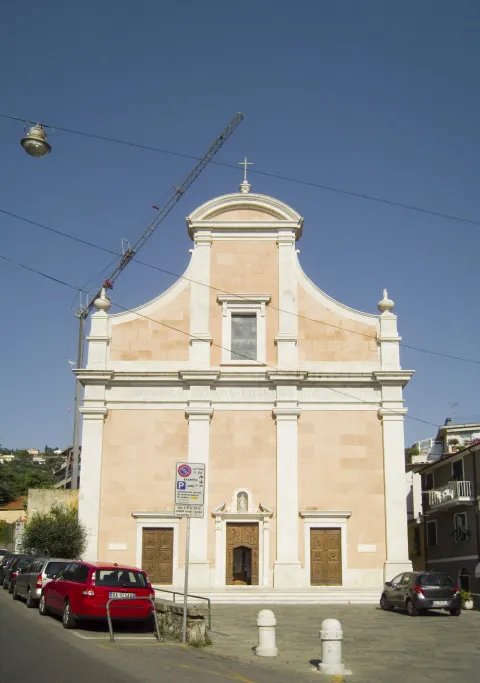
The wooden Saint Roch standing in the middle of the nave is the first known work of Domenico Gar, a sculptor of French origin who worked in the lower Val di Magra: he carved it in 1524. The church that holds it is far older than he was. It appears as plebem de Trebiano in a bull of Pope Eugene III in 1149, when it was a baptismal church with jurisdiction over the chapels around it; the building you see today, however, is a sixteenth-century reconstruction, and of the Romanesque fabric little survives beyond the documents. It is still the parish church of the Media Val di Magra vicariate, in the diocese of La Spezia-Sarzana-Brugnato.
What to see
In the Mascardi chapel, which occupies the surviving wing of the earlier building, stands a marble altarpiece known as the Icona pulchra, also by Domenico Gar. Three reliefs run along the predella: episodes from the life of Saint Bernard of Clairvaux, the Nativity, and Saint Catherine of Alexandria with broken chains, an iconographic detail you do not meet often.
In the small left aisle hangs a wooden Cross painted on a squared ground, incomplete in places and restored not long ago: before coming back here it spent a period in the diocesan museum of La Spezia. On the altar there is a wooden Madonna of the seventeenth century. The rest of the furnishing is made of minor paintings and sculptures, gathered over the centuries without any single plan.
Visiting
The church faces piazza della Chiesa, in the core of Trebiano, a hill hamlet of Arcola: cars stay at the edge of the village and the last stretch is done on foot, along narrow lanes. It is a working parish, so opening follows the times of services; outside them it is worth asking in the village. The interior is compact and can be seen calmly in about twenty minutes, longer if you stop in front of the painted Cross, the one piece worth going back to twice.
Our editors' tip
We suggest looking at the predella of the Icona pulchra from close up and, if you can, in raking light: Gar carved in very low relief, and the details of the three panels are lost in a frontal glance. Then go back to the Saint Roch: knowing it was the debut of a sculptor nobody yet knew changes the way you look at it.