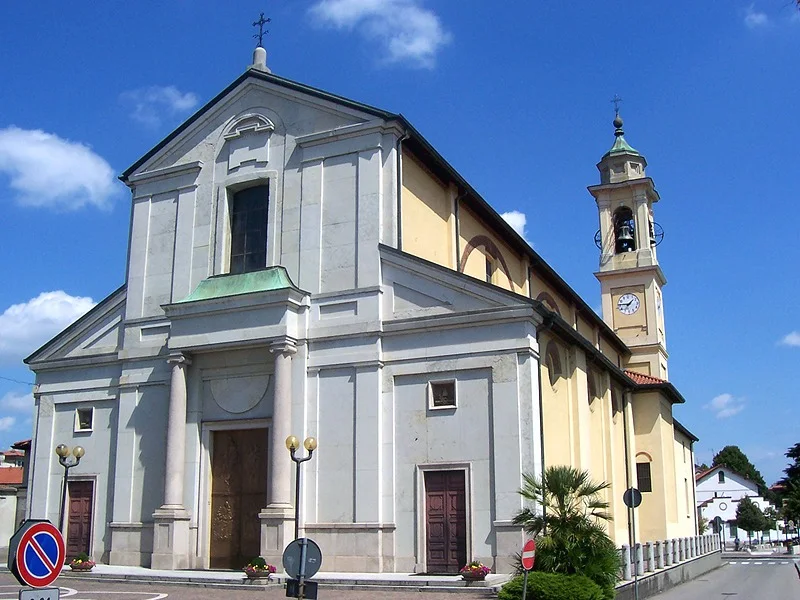
Cambiago lies in the Martesana, north-east of Milan; in Brianza dialect it is Cambiagh. The ending -ago, common hereabouts, points to Celtic origins, and the root is said to come from an Indo-European word for a settlement, cambria, later reshaped as Cambia. Before the twelfth century the village already had two churches and a house of Umiliate nuns, one of thirteen counted across the Martesana in a catalogue of 1298. Torrazza dei Mandelli, a separate comune in past centuries, held the country seat of the patrician Mandelli.
Annexed to Gessate in 1809, Cambiago won its independence back only in 1816, with the Austrian Restoration; in 2005 a referendum on joining the new province of Monza e Brianza ended with residents choosing to stay with Milan. The arms, a silver chape on red, are used without a grant decree and come from those of the old Comunità di Cambiago and of the Lombard de Cambiago family. Library and auditorium occupy a restored silk mill that also names the town newsletter, while the works founded by the craftsman Ernesto Colnago, with its museum of bikes and jerseys, made the place known among cyclists.
Straight-line distances from the town centre. Tap a point to open its page.
Near Cambiago
The closest destinations covered by our editors, with straight-line distance.


Places to see within 25 km
Outside Cambiago, but an easy day trip away.