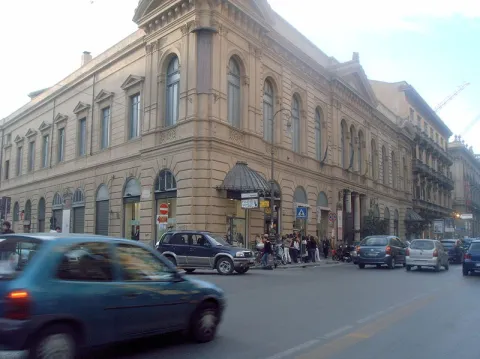
The marble Riso coat of arms is still above the main doorway on Corso Vittorio Emanuele: it was carved by Ignazio Marabitti, who also made the neoclassical figures on the central balcony. The palace, however, began as the Belmonte residence. Giuseppe Venanzio Marvuglia designed it and completed it in 1784 for Prince Giuseppe Emanuele Ventimiglia; only in the nineteenth century did it pass to the Riso barons, whose name it still carries. A bomb brought down part of it during the Second World War, and after decades of neglect restoration resumed in the mid-1990s. In 2008 the building reopened as the contemporary art museum of the Sicilian Region.
What to see
Marvuglia was working at the exact moment when the Sicilian Baroque was closing and neoclassicism taking over: the front on the corso, the portal and the balcony sculptures tell that shift better than a textbook. Inside, the museum does not hide its war wound. The wings destroyed by the bombing were never rebuilt and survive only on the drawing board as a planned extension, so the rooms of the piano nobile sit alongside raw, unfinished spaces. It is a building that carries large-format installations well.
The permanent collection brings together the Sicilians who shaped Italian abstraction, Carla Accardi, Antonio Sanfilippo and Pietro Consagra, artists such as Emilio Isgrò, Giovanni Anselmo, Salvo and Paola Pivi, international names including Christian Boltanski and Richard Long, and the Palermo generation of Alessandro Bazan, Francesco De Grandi, Fulvio Di Piazza and Andrea Di Marco. The museum opened together with SACS, the Sicilian contemporary art desk: an archive you can consult online or on paper on site, joined in 2010 by the SACS Gallery, which shows younger artists.
Visiting
The museum stands on the Cassaro, the straight street that cuts through the old city: from the Quattro Canti crossroads it is a few minutes on foot towards the Cathedral, and the city-centre bus stops are all around. The programme is built on temporary exhibitions, so the permanent collection is not always fully on display. Check what is on before you set out, since some rooms close between one installation and the next. Bookshop and café are on the ground floor, added with the 2008 works. Three quarters of an hour is enough for the round, an hour and a half when a large show takes over every floor.
Our editors' tip
We come in the late afternoon, once the corso has stopped baking, and we always ask two things at the desk: whether the courtyard is open, and what is hanging in the SACS Gallery, often the liveliest part of the museum. After a morning of stucco and Baroque churches, half an hour in front of a contemporary installation resets the eye; on the way out, stay on the same pavement and walk on to the Cathedral.