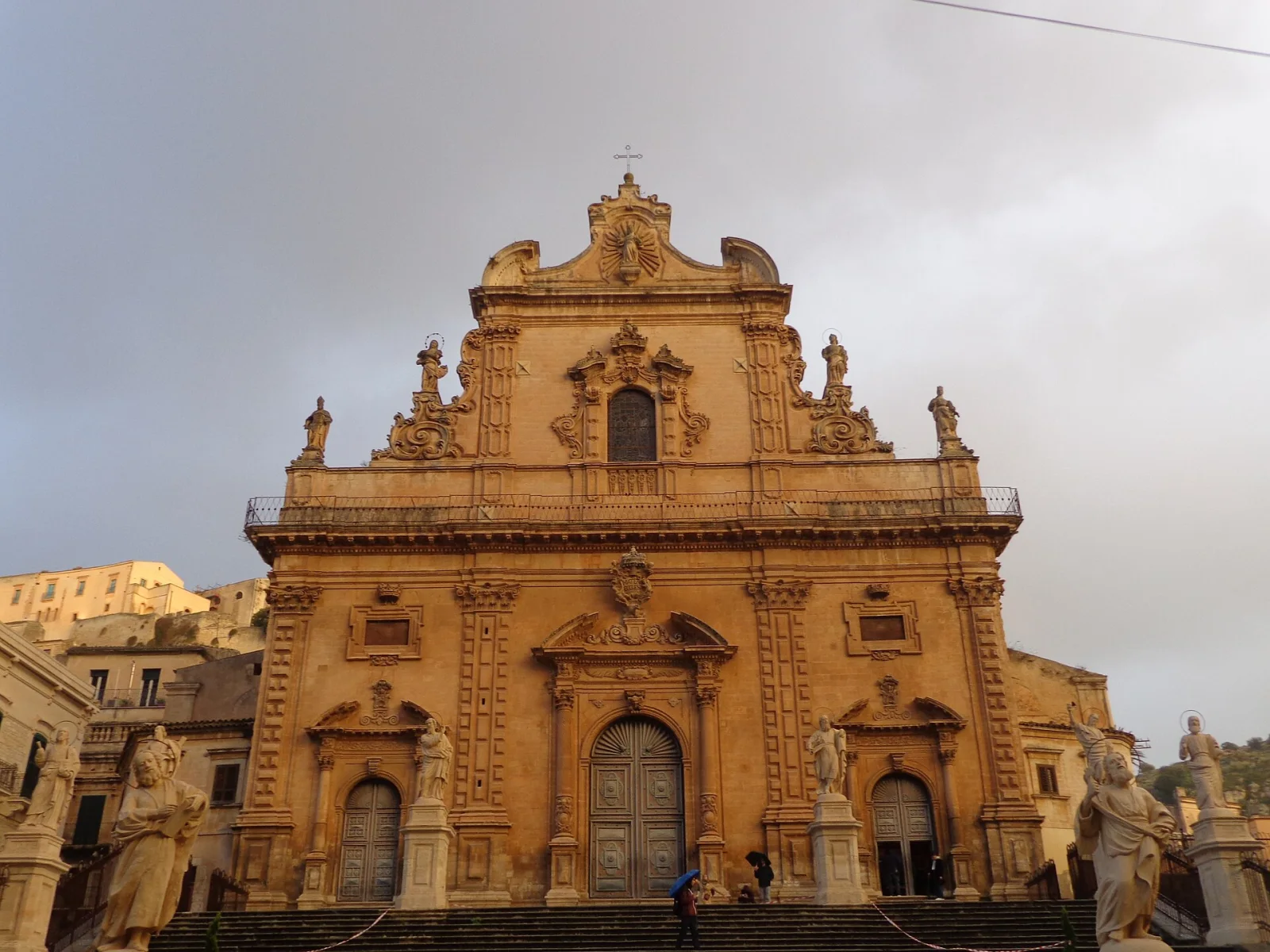
Modica has two mother churches, and for centuries they were rivals: San Pietro is the eternal counterpart of San Giorgio. Dedicated to the apostle Peter, it stands in the lower town; a church already existed here in the fourteenth century, and was raised to a collegiate church in 1597. Its self-proclamation as mother church, against San Giorgio — the “official” church of the counts of Modica — lit the long feud between the “Giorgesi” and the “Pietresi”, made of spite, bans and even stone-throwing, settled only by a royal decree of Charles III of Bourbon.
What to see
The drama begins already on the staircase that climbs from Corso Umberto I: along the steps stand the statues of the twelve apostles, which the people of Modica fondly call the “santoni”, by Salvatore Ammatuna and his pupil Pietro Petracolo. The two-order façade is crowned by the “MATER ECCLESIA” coat of arms and four statues, among them the co-patron San Cataldo. Inside, three naves with fourteen Corinthian columns, the marble-inlay floor of 1864 and the frescoed vaults stand out. Not to be missed is the Cappella Mazara, now the parish museum, which holds a marble Madonna del Soccorso of 1507, of the Lombard school. In the bell tower rings “Petra”, the largest bell in Modica, twin of “Ippolita” at San Giorgio.
Visiting
The church owes its present look to the many rebuildings after earthquakes: one element, though, held firm — the side chapel of the Immaculate, which bears the incised date 1620 and survived even the quake of 1693. The visitor routes include, besides the Cappella Mazara museum, the monumental organ and the climb up the bell tower.
Our editors' tip
See it paired with San Giorgio: the two mother churches, with their twin bells “Petra” and “Ippolita”, tell the divided, proud soul of Modica better than any guidebook. And pause at the “santoni” on the staircase: they are the most Modican welcome there is.


