Modica

Province: Ragusa · Region: Sicily · Population: 53,959 · Postal code: 97015

In its first edition, in 1934, the Treccani encyclopaedia called it «the most singular city in Italy, after Venice», taking up the impression of an abbot who had passed through more than a century earlier. The reason is under your feet: Corso Umberto, the main axis, is a covered torrent — the Modicano, which turned twenty-three water mills here and beneath which the arches of its seventeen bridges remain. The town around is a baroque nativity scene on two levels, rebuilt after the earthquake of 1693 and a UNESCO site with the Val di Noto: the cathedral of San Giorgio rises above the roofs on its theatrical staircase.

Until the nineteenth century Modica was the capital of a county that also ruled Ragusa, Scicli and Pozzallo, among the most powerful fiefs of the Mezzogiorno; the comune is very long and drops from the Hyblaean Mountains down to the sea, where it has its two seaside hamlets. The chocolate is worked cold, as the Spanish learned it from the Aztecs: grainy, pure, today protected as an IGP — the old chocolate shops on the corso are compulsory stops. Salvatore Quasimodo, Nobel laureate for literature, was born here in 1901, and his birthplace can be visited. Upper and Lower Modica are stitched together by stairs and alleys that turn gold at sunset; mpanatigghi, pastries of meat and chocolate, are the most disconcerting taste of all.

Fun facts about Modica

Modica's chocolate is still made the way the Spanish rulers of the old County learned it from the Aztec xocoatl tradition: worked cold, at low temperature, so the sugar never fully melts. The result is a grainy, crunchy bar unlike anything else made in Europe — and in 2018 it became the first European chocolate to earn PGI status. The same Spanish era left behind the 'mpanatigghi, half-moon pastries filled with chocolate, almonds, spices and, yes, minced beef.

For more than five centuries the town was the seat of the County of Modica, a feudal state so powerful and so autonomous that contemporaries called it a kingdom within the kingdom. The earthquake of 1693 flattened most of it; the rebuilding produced the late-baroque townscape that joined the UNESCO-listed Val di Noto towns in 2002, with the Duomo di San Giorgio as its centrepiece. Locals also count around a hundred churches, hence the town's nickname.

Salvatore Quasimodo, winner of the 1959 Nobel Prize in Literature, was born on via Posterla on 20 August 1901. His birthplace is now a small museum, and every August the town marks his birthday with readings and literary walks.

Tours, tickets and experiences

Experiences in Modica

Bookable on GetYourGuide

🎉 Festivals and feasts in Modica 5

Patron saint festival

Feast of Saint George

📅 Every year, usually on the Sunday after 23 April

Carried at a run by the Sangiorgiari, the statue of Saint George spearing the dragon races through upper and lower Modica before a fireworks-lit return to the cathedral.

Patron saint festival

Feast of Saint Peter

📅 Every year on 29 June

On 29 June the 1893 oak statue group of Saint Peter healing the paralytic is carried along Corso Umberto I; the evening return is lit by torches, with the traditional fair alongside.

Procession

Madonna Vasa-Vasa

📅 Every year on Easter Sunday

At noon on Easter Sunday the articulated statue of the Madonna bows and kisses the risen Christ; her black mourning cloak falls away and white doves take flight. Documented since 1645.

All 5 events in Modica →

🍝 The flavours of Modica

Everything to eat in Modica →

Street food PAT

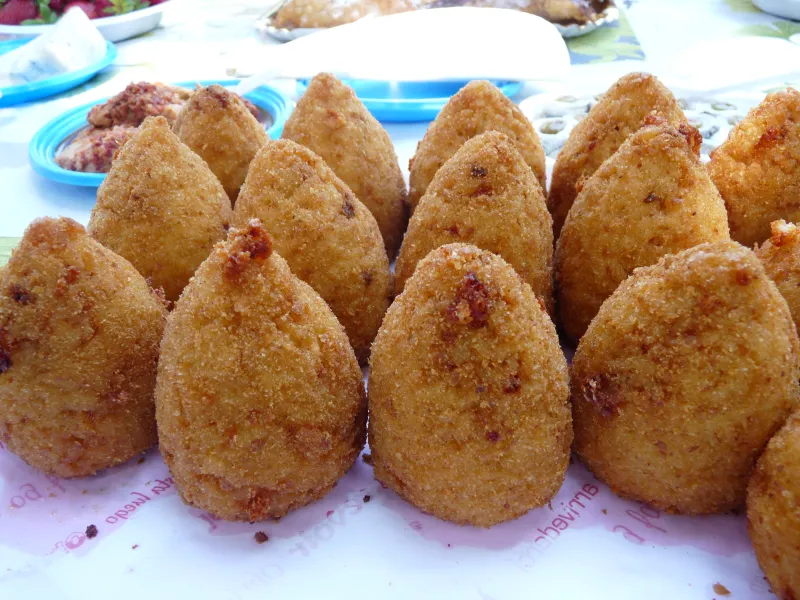
Arancino fried rice cone stuffed with ragù, pointed like Etna

Saffron rice, ragù with peas and caciocavallo inside a golden cone-shaped crust: in Catania it is masculine and pointed, and the quarrel with Palermo over the name is serious.

Read more →
What's around

Straight-line distances from the town centre. Tap a point to open its page.