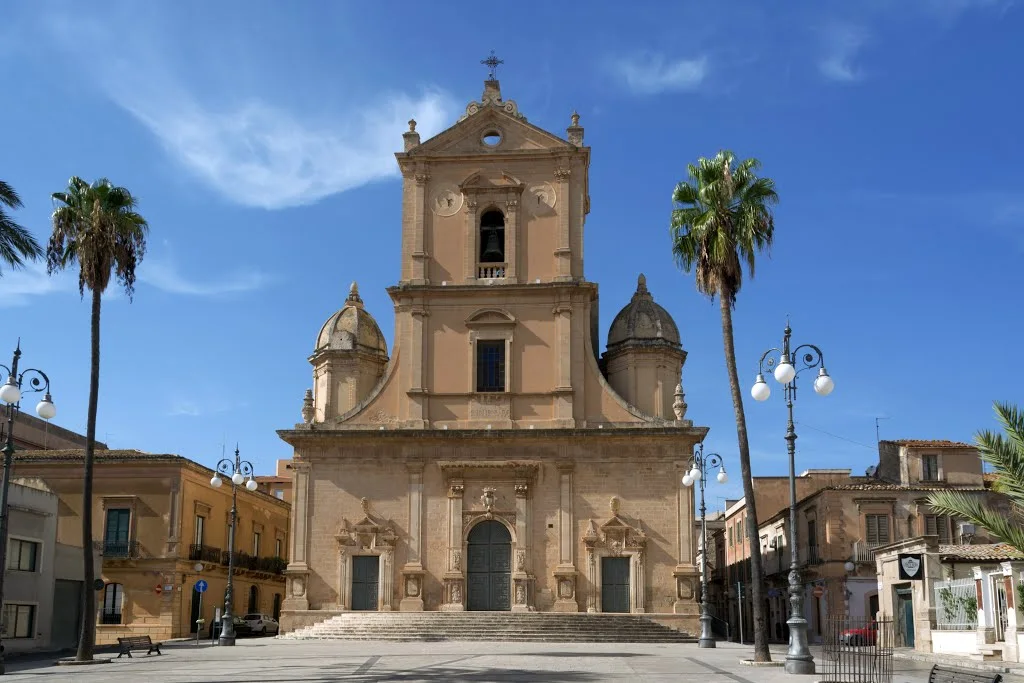
The basilica of San Giovanni Battista is the mother church of Vittoria, in the historic centre, in piazza Ferdinando Ricca; it has the dignity of a minor basilica.
What to see
It is a Latin-cross church, with three naves on Corinthian columns, in clear Baroque style, built between 1695 and 1706, after the earthquake of 1693, in place of the old church in piazza della Trinità, and consecrated in 1734; the façade is simple, topped by two small domes, with the central part framed by pilasters with Ionic and Corinthian capitals. Before the quake the church on the Trinità plain was linked to the convent of the Grazie; in the earthquake of 1693, according to some, only forty catechism children died inside it, and to choose which saint to thank the names of the venerated saints were put in an urn: three times the name of Saint John the Baptist came out. The first stone was laid on 10 August 1695 by the parish priest Mario La Lisa; don Desiderio Ricca, first archpriest of Vittoria, made the late-Baroque façade and went on decorating the church with new altars; in 1734 the Bishop of Syracuse Matteo Trigona consecrated it and in 1750 it was raised to a minor basilica and attached to Santa Maria Maggiore in Rome, from which many relics came. The Moorish-style dome, designed by Giuseppe Di Bartolo Morselli, was finished in 1854, and in 1880 Giuseppe Mazzone frescoed the four evangelists.
The interiors are rich, with decorations, stuccoes, statues, marbles and numerous canvases. There are a fine wooden altar, works by Giuseppe Mazzone, among them the famous «Taledda», and by other Sicilian artists; the tomb of the Countess of Modica Vittoria Colonna, founder of the city; the baptismal font, topped by a Baptism of Christ of the Caravaggesque school, datable around 1700; the wooden pulpit by Carmelo D'Asta, of the nineteenth century, and, in the central nave, the organ by Donato Del Piano, of 1748, with fourteen stops.
Visiting
The basilica is in piazza Ferdinando Ricca, in the historic centre of Vittoria. The sources consulted give no opening hours or visiting arrangements: check them.
Our editors' tip
The book by the parish priest Federico La China, «Vittoria from 1607 to 1890», is still used today to reconstruct the city's history.