The arms of the comune are those of the Plazoll zu Assling, in the Middle Ages lords of Pfalzen, who had the castle of Sichelburg built — and Sichel, in German, is the sickle: so on the shield, party per pale silver and red, there is a sickle on each side, each in the colour opposite to its own field. The name of the village, instead, is much older and has nothing to do with sickles: it would go back to the late Latin Palantium, the residence of a prince, a spiritual one too, itself of pre-Latin origin. A document of 1050 gives it in the forms Phalanza, Pfalenz, Phalenze, and around the thirteenth century it settles into Phaltzen. The Italian form, Falzes, takes up not the German name but the Ladin one.
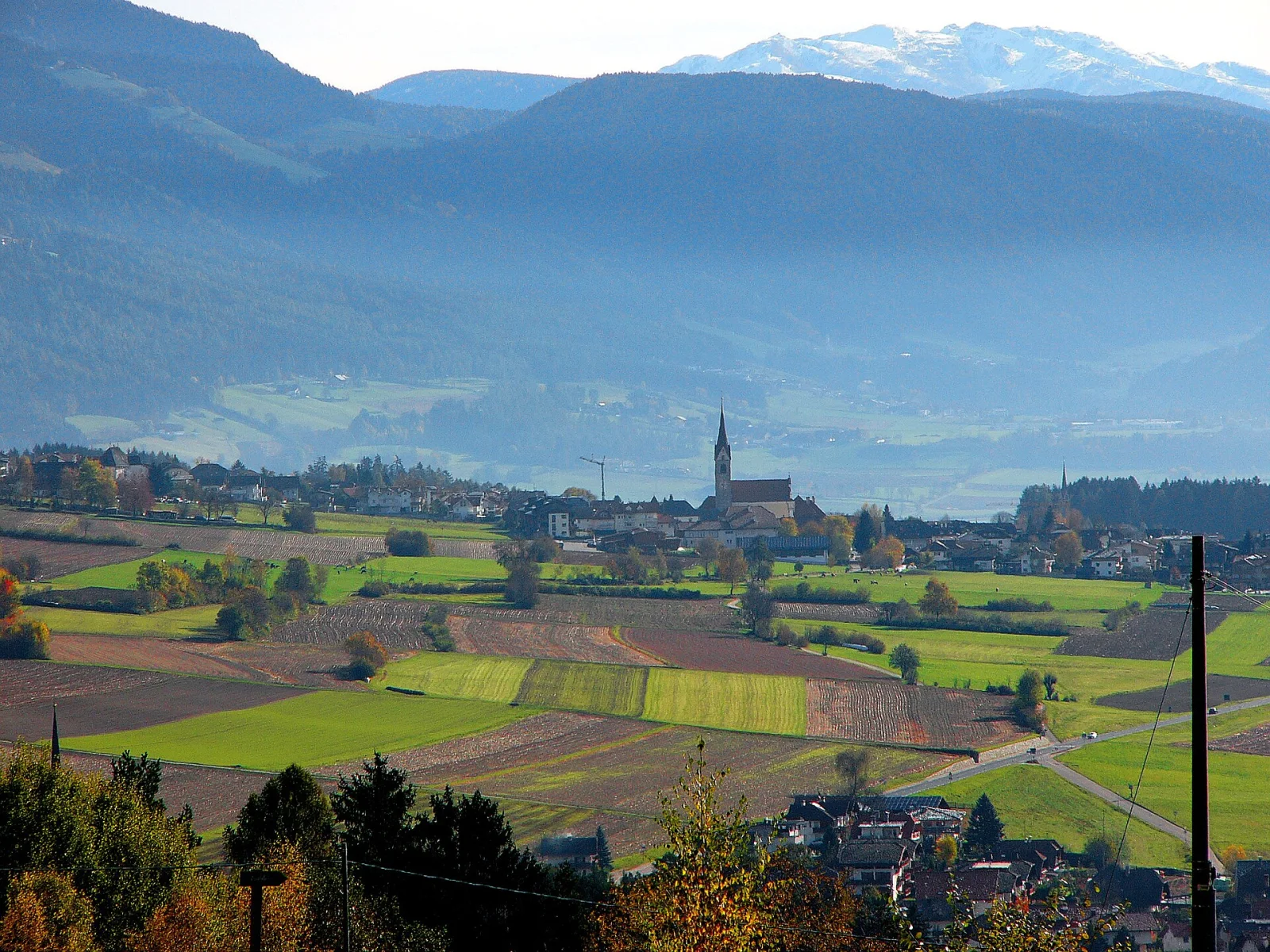
The hamlet of Grimaldo — Greinwalden in German — was founded in the early Middle Ages by a Bavarian nobleman named Grimoald, and still carries his name. The village was then held in fief by the lords von Pfalzen, ministeriales of the bishop of Bressanone, and passed thereafter to the counts of Tyrol, then to those of Gorizia and finally to the Habsburgs. Of the two castles, Sichelburg gave the arms and Castel Schöneck, which is of the twelfth century, may have given something else: it is one of the two places that claim the birth of Oswald von Wolkenstein, the great poet and composer of the late Middle Ages — the other is in the Val Gardena, and the question is not settled. The church of San Valentino is of the fifteenth century and keeps frescoes and a wooden statue of the saint of the same date as the building. Here almost everybody speaks German; and from Falzes comes Luis Durnwalder, who led South Tyrol for twenty-five years.
Straight-line distances from the town centre. Tap a point to open its page.
Near Falzes
The closest destinations covered by our editors, with straight-line distance.


Places to see within 25 km
Outside Falzes, but an easy day trip away.