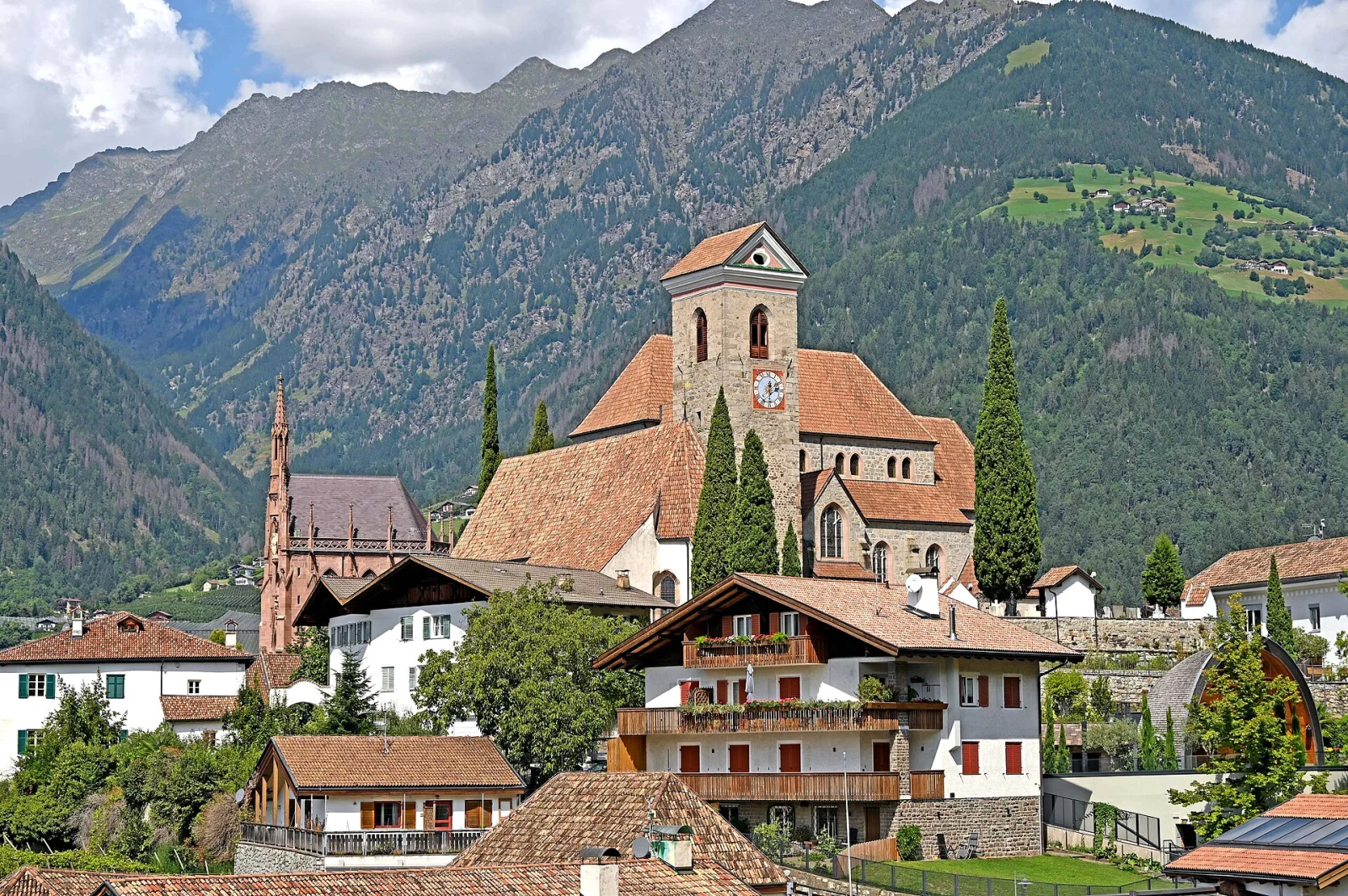
In 1845 the archduke Johann of Habsburg-Lorraine bought the castle of Scena, and on the twenty-fourth of June 1869 he was buried here, in the neo-Gothic mausoleum built beside it, where his family lies as well. The castle had been the seat of the lords of Scena, who held the lordship from about the middle of the twelfth century until they died out, in 1369, and their emblem — a red lion issuing from a black field, on silver — is the coat of arms the comune uses. It was in use before the First World War, then no longer; a resolution of the town council restored it in 1967. Inside the castle is the largest private collection devoted to the Tyrolean fighter Andreas Hofer.
The name is attested between 1116 and 1122 as Schennano and in 1270 as Schenan, and philologists derive it from a Latin personal name, Sconius, presumably a landowner. But there is a second reading, and it is the reason why for a long time it was written Schönna: schöne Au, the lovely meadow. The local dialect still says Schönnen. Here, in the Burgraviato, almost everybody has German as a mother tongue — about ninety-seven in a hundred at the last count, the rest Italian and a handful of Ladin speakers; and the villages have two names apiece, Schennaberg and Montescena, Tall and Valle. From the sixth and seventh centuries people began arriving here from Franconia and Bavaria; before them, if the philologists are right, there had been a Roman with an estate.
Straight-line distances from the town centre. Tap a point to open its page.
Near Scena
The closest destinations covered by our editors, with straight-line distance.


Places to see within 25 km
Outside Scena, but an easy day trip away.