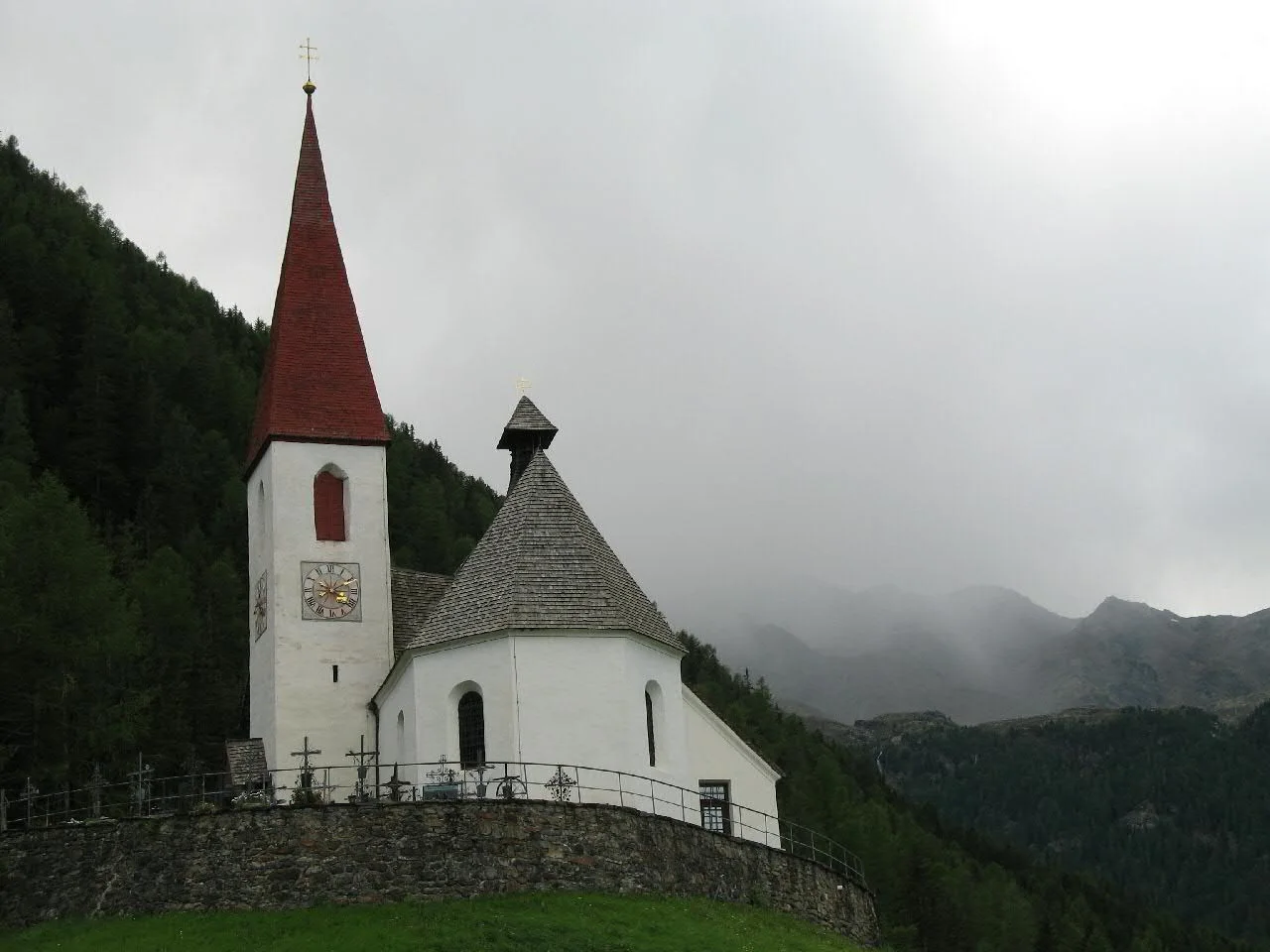
The name of this comune means the last one, and it is a geographical description: the Val d'Ultimo is a side valley branching off the Adige and ending against the mountains, and the village lies at its far end. The place name is documented as Ultun as early as the eleventh and twelfth centuries, then as Ultime, Ulten and Ultimis, and comes from the Latin ultimus, farthest. The historical micro-toponymy of the valley is almost entirely German, and this tells us that the Bavarians colonised it capillary-fashion in the early Middle Ages, farmstead by farmstead. Until the early modern age the valley was a judicial district of the counts of Tyrol, divided into twelve Werchen and administered by the prince's officials: in a document of 1434 appears Ulreich Fulhyn, phleger in Ultenn, that is the administrator in Ultimo. The comune as we know it today was created in 1810 by joining five localities, and one of them, San Pancrazio, later separated again.
At Santa Gertrude, in the locality of Klapfberg, there are three larches held to be a thousand years old, and the reason we can say so is that a fourth one fell. That tree was brought down by a storm in the nineteen-thirties, and counting its rings some two thousand were found: from that the age of the brothers left standing was deduced. The province has classified them as natural monuments, that is it protects them as one protects a building. The coat of arms of the comune, adopted in 1967, carries the insignia of the counts of Eschenlohe, who took over from the counts of Ultimo when that house died out, with the eagle declaring their membership of Tyrol. Here German is the mother tongue of very nearly all the inhabitants.
Straight-line distances from the town centre. Tap a point to open its page.
Near Ultimo
The closest destinations covered by our editors, with straight-line distance.


Places to see within 25 km
Outside Ultimo, but an easy day trip away.