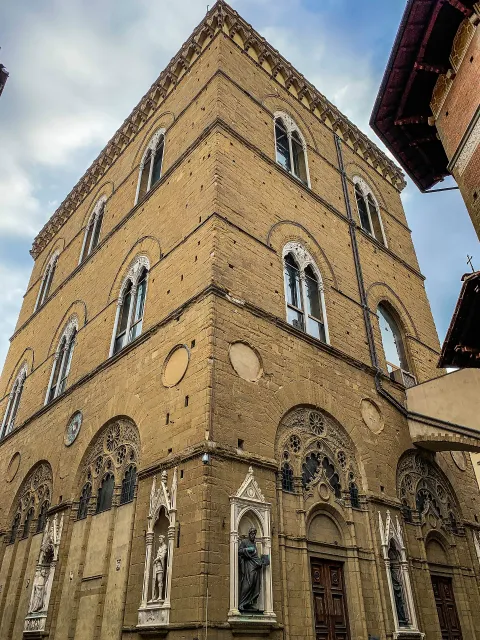
Before it was a museum this was a building yard. From the thirteenth century the premises housed the Opera del Duomo, the body created by the Florentine Republic and overseen by the wool guild, whose task was to build, furnish and maintain Santa Maria del Fiore. In the fifteenth century there was a courtyard here that Brunelleschi used as a timber store for the dome, and here too, around 1500, Michelangelo carved the David. The museum gathers the works taken over the centuries from the three monuments of the square: the cathedral, the baptistery and the bell tower.
What to see
The front that no longer exists. The medieval one by Arnolfo di Cambio was demolished in 1587, and the museum keeps two things from it: a full-size replica of the unfinished front, with the original fourteenth-century sculpture groups mounted on it, and, in an adjoining room, the real fragments of the demolished front, in inlaid and mosaic marble. In the same hall stand the three bronze doors of the baptistery, the one by Andrea Pisano with the stories of the Baptist and the two by Lorenzo Ghiberti, with the stories of Christ and those of the Old Testament.
Visiting
Look for the faces. Donatello's prophet Habakkuk was nicknamed lo Zuccone by the Florentines, on account of his bald skull, and the nickname has stuck to him ever since. By Donatello too is the penitent Magdalen in polychrome wood, which came from the baptistery. And there is the Pietà that Michelangelo carved for his own funerary monument: in the face of the Nicodemus holding up the body of Christ he portrayed himself. In another room the two singing galleries, one by Luca della Robbia and one by Donatello, are shown facing each other.
Our editors' tip
It is worth knowing why this museum exists. At the end of the nineteenth century the Opera del Duomo had to decide what to do with the works by then detached from their original settings, beginning with the two singing galleries: send them to the city's other museums, or keep them where people could see them. It chose to turn some rooms of its own offices into exhibition space, and in 1891 it opened to the public. Then look for Brunelleschi's death mask, displayed between the two original wooden models of the dome and the lantern, together with the actual tools from the building site.