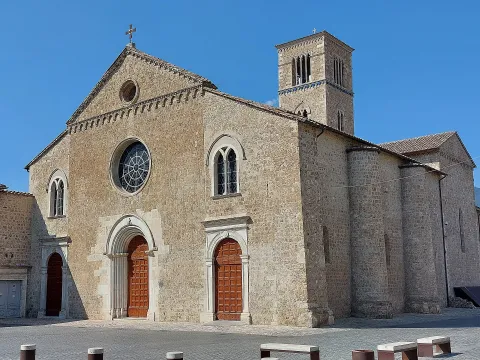
The cathedral of Santa Maria Assunta is the duomo of Terni and the cathedral of the diocese of Terni-Narni-Amelia: a building that grew out of the series of constructions and interventions that followed one another over the centuries, with an ancient crypt and an interior that brings together Renaissance, Baroque and contemporary works.
What to see
The façade has a wide portico with a double order of columns, in which three Romanesque-style doors open, enriched with friezes; the upper part is modern work, with a travertine balustrade and statues of eight bishops of Terni, among them Saint Valentine, to a design by Marcello Piacentini. The interior is a Latin cross with three aisles divided by piers, side chapels, a transept and an apse. On the inner façade is a large fresco painted in 2007 by the Argentine painter Ricardo Cinalli, the Rete mistica, which shows the resurrection of the bodies at the Last Judgment and is peopled by contemporary figures. In the presbytery are the 17th-century organ and the wooden choir carved by Domenico Corsi in 1559, and in the apse a 17th-century fresco with the city's patron saints and angels. Among the other works are the baptismal font of 1585, with the arms of the comune that financed it carved on it, the Noli me tangere attributed to Guido Reni, the Agony in the Garden by Francesco Romolo Cincinnato, the tabernacle by Carlo Murena with relics of the blood of Christ and, in the right transept, an Immaculate Conception by Ippolito Borghese. In the crypt is the tomb of Saint Anastasius, built from a pagan altar enriched with Cosmatesque tiles, others of which are kept in the sacristy.
Local tradition holds that the first cathedral, corresponding to the crypt, was built over the remains of a Roman pagan temple by the holy bishop of Terni Anastasius; the consolidation works between 1932 and 1937, to plans by Marcello Piacentini, brought to light in the crypt area three buried apses and the remains of a rose window with side two-light windows. In the 9th century, because of the buried position in which the crypt had come to lie, renovation works were carried out, resumed in the 12th century; little remains of the Romanesque cathedral, because of the modernisation works of the 16th and 17th centuries, with the raising of the central nave, the rebuilding of the tribune and bell tower, the baptismal font, the side chapels and the definitive Baroque arrangement of the cathedral and the square in front of it, to designs attributed to Gian Lorenzo Bernini. As for the side tower, in the 16th century there was a dispute over its placement: in the end it was set to the left of the apse and rebuilt in 1743.
Visiting
The duomo is a working church; opening hours and service times, and access to the crypt, should be checked with the diocese, because the sources consulted do not give them.
Our editors' tip
Look at the inner façade: in Ricardo Cinalli's Rete mistica, of 2007, the Last Judgment is crowded with contemporary faces, a deliberate contrast with the 16th-century wooden choir and the ancient crypt.