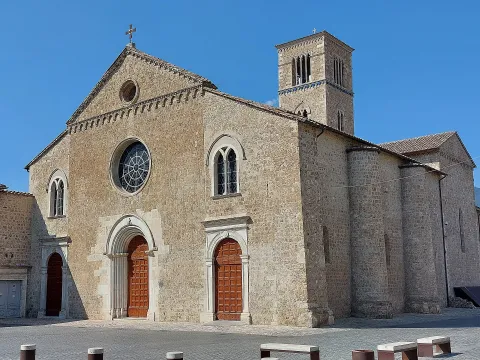
The shrine of Saint Anthony of Padua and of the Holy Franciscan Protomartyrs is a Catholic place of worship in Terni, seat of the parish of the same name; because of its position, between the station and the steelworks, it is regarded as the city's «working-class» parish.
What to see
Inside are kept the relics of the Franciscan protomartyrs, the saints Berard, Otho, Peter, Accursius and Adjutus, shown with scenes from their lives in a large panel by Piero Casentini. Opposite is a relic of the body of Saint Anthony and a second panel by the same Casentini, with a new iconography of the saint of Padua. Among the other works are an oil canvas of Saint Rita of Cascia, made in 1938 by the Franciscan Missionary Sisters of Mary of Rome, a mosaic of Saint Francis of Assisi, Saint Louis IX and Saint Elizabeth of Hungary made by the Vatican Mosaic School, and a statue of Padre Pio of Pietrelcina by artists from Ortisei. The white marble statue of the Sacred Heart is by the Terni sculptor Guglielmo Colasanti (1889-1944); the Way of the Cross in embossed copper and the doors are by Nadia Lucidi.
Two candidates competed to design the church, the Franciscan tertiary Aristide Leonori, whose cause for beatification was opened in 1933, and Father Mario Mazzarra, but neither won the commission: the building is the work of the architect Cesare Bazzani and was built between 1923 and 1935. Since 13 June 2010, by decree of Bishop Vincenzo Paglia, it has been the Antonian Shrine of the Franciscan protomartyrs, the five friars whose death was, according to tradition, at the origin of Saint Anthony's Franciscan vocation. The twenty-two polychrome windows by Vittorio Cecchi show the theological virtues, episodes from the life of Saint Francis, prudence and temperance, and the symbols of the saint of Padua: the lily, the boat, the books, the miracles.
Visiting
The church stands in the area between the railway station and the steelworks, in Terni; service and opening times should be checked with the parish, because the sources consulted do not give them.
Our editors' tip
Look at the twenty-two windows: besides the virtues and the life of Saint Francis, they carry the signs by which Saint Anthony is recognised, the lily, the boat and the books.