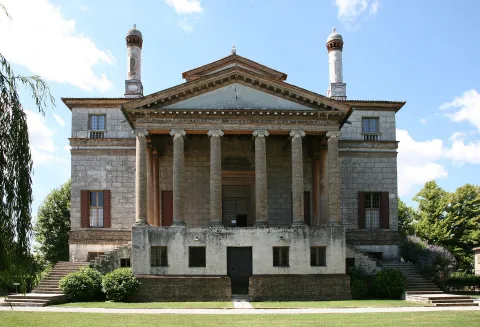
The church of Santa Maria Assunta is the parish church of Borbiago, a hamlet of Mira, and is known as the sanctuary of the Madonna Mora. The parish of Borbiago is first mentioned in 1152, in a bull by which Pope Eugene III confirmed the rights of the bishop of Treviso; after a period under the Benedictine abbey of Sant'Ilario, in 1260 it returned to the diocese of Treviso, on which it depended until 1927. Rebuilt in a time of constant conflict, it was reconsecrated on 25 March 1381, with a large contribution from the lord of Padua, Francesco il Vecchio da Carrara, who was devoted to the Virgin. The Benedictines held it until 1450, then came the Carmelites, who stayed until the convent was suppressed in 1768.
What to see
The venerated image is a Virgin and Child in painted soft stone, from the end of the fifteenth century, the work of Andrea Briosco, kept in the crypt beneath the presbytery. The ceiling is taken up by a large oil painting by Gaspare Diziani, painted between 1728 and 1731, with the Virgin giving the scapular to the Carmelite Saint Simon Stock: it is more than eleven metres long. There is also an altarpiece of Jesus appearing to Saint Teresa of Avila, attributed to the school of Palma il Giovane.
The Marian sanctuary was built in 1662. The façade is not old: the brick one of 1940 was damaged by a tornado in 1970 and demolished, and in its place the one seen today was made.
Visiting
Opening and Mass times should be checked with the parish of Borbiago.
Our editors' tip
Tradition tells that a deaf-mute girl, outside the church, saw the Madonna, who showed her the spot where a statue with her image lay buried; having regained her speech, she called the monks, who found a marble Madonna with a bronze bell on her head. Where the well stood a votive shrine was placed. The documents in the archive, however, do not match the story, which sets the event in the twelfth century: the statue dates from the end of the fifteenth.