Patron saint festival In 250 days
Saint John the Baptist and Villa Godi
📅 Every year, on 24 June
Lugo di Vicenza celebrates Saint John the Baptist on 24 June, in the church dedicated to him.
The name comes from the Latin lucus, the sacred wood, and the wood has stayed in the names of the contrade — Boschetti, Roveri. In 917 the emperor Berengar gave the whole strip between the Astico and the Brenta, the Asiago plateau included, to Sibicone bishop of Padua, with the obligation to build castles against the Hungarian raids; around those years Lugo too had its own defensive work, on the height where the church of San Pietro now stands. That by the early thirteenth century it was gone is known from a silence: when in 1223 Ezzelino the Monk divided his goods among his sons and the Lugo area went to Ezzelino III, no castle was mentioned. In 1034 the curtis de Luco belonged to the Benedictine nuns of a monastery in Padua.
Lugo stayed joined to Calvene until 1390, when it became a comune of its own. The plague of 1629 left more than a hundred dead and a place name, Lazzaretto, to the south-west of the old centre. The paper mill on the left bank of the Astico has existed since 1500, and in the nineteenth century Bernardino Nodari equipped it with the first continuous machine installed in Italy; its paper won a prize at the Turin exhibition of 1884. On the hill of Lonedo stand Villa Godi and Villa Piovene, both by Palladio, and high up in the Vanzo area, at one thousand and sixty metres, grows the largest beech in the Veneto: twenty-six metres tall.
No events match these filters.
📅 Every year, on 24 June
Lugo di Vicenza celebrates Saint John the Baptist on 24 June, in the church dedicated to him.
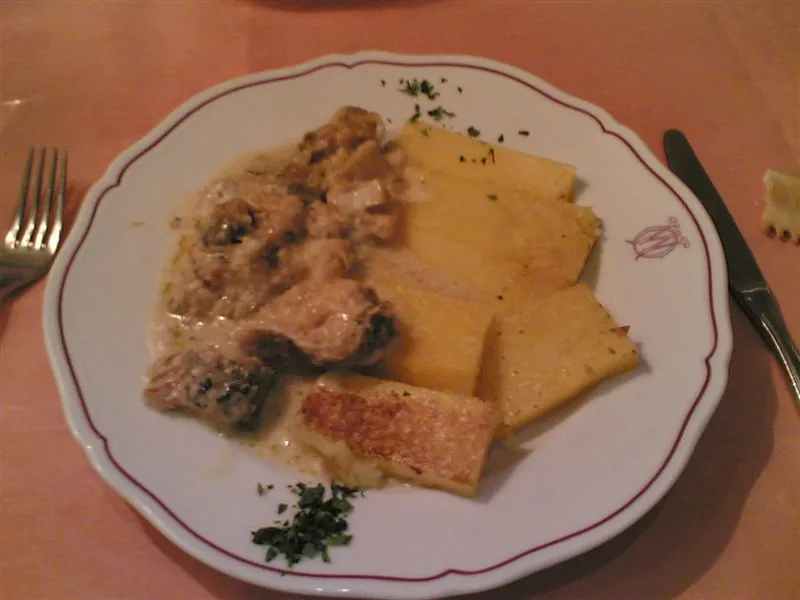
Stockfish, milk, oil and anchovies, cooked for hours over the lowest heat: baccalà alla vicentina arrived from Norway with a shipwreck in 1432.
Read more →Straight-line distances from the town centre. Tap a point to open its page.
The closest destinations covered by our editors, with straight-line distance.