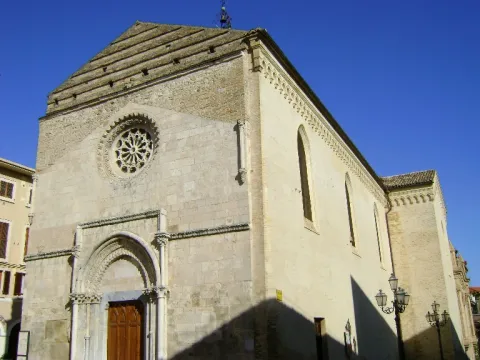
The church of Maria Santissima del Carmine stands in the historic centre of Vasto, beside the palace that now houses the diocesan curia. In its place stood the church of San Nicola degli Schiavoni, recorded in 1362 and served by the confraternity of the same name: it was the church of the town's Slav families, who in 1522 numbered fifty and were later gradually absorbed. In 1638 the old church was demolished and a new one built, dedicated to Our Lady of Mount Carmel, where Saint Nicholas continued to be venerated at a minor altar. Diego I d'Avalos called from Naples the Clerics Regular of the Mother of God, known as the Lucchesi fathers, who founded a convent with a college.
What to see
The present building was rebuilt between 1758 and 1761 to a design by the architect Mario Gioffredo, and in 1762 the interior was decorated with stucco by Michele Saccione of Naples. It is in exposed brick, without the plaster that had been planned; the façade, marked by pilasters, has an entrance preceded by a monumental double-flight staircase, a large window in line with the portal and a triangular pediment. Beside it rises a Baroque bell tower of trapezoidal section, and a small shallow dome covers the transept.
On the high altar is the Presentation of the Infant Mary to the Eternal Father by Crescenzo La Gamba. On the side altars, to the right is Saint Benedict in the Cave by Nicola Tiberi, to the left Our Lady of Mount Carmel with Saint Nicholas and Saint Andrew by Giulio de Litiis; in the minor chapels are the Ecstasy of Saint Teresa of Avila and the Crucifix with Saints by the Neapolitan Fedele Fischetti.
Visiting
The church is a subsidiary of the parish of the co-cathedral of San Giuseppe. In 2009 the old confraternity of the Carmine was re-established and helps run worship here; opening and service times should be checked with the parish.
Our editors' tip
By the altar of the right transept is the urn with the body of Saint Theodore, which arrived in Vasto on 4 December 1751 and was then acclaimed patron of the town. The convent and college of the Lucchesi fathers were instead abandoned at the start of the nineteenth century, with the suppression of the religious orders.